I sometimes wonder whether a good way to get an early idea of someone's character would be to observe how that person drives. This could indicate such things as self-control, risk taking, patience, politeness, reliability, responsibility, and empathy.
An exception to this is that some bad driving habits might come more from not learning the right way. For example, I once met someone who grew up in China before driving was common there and learned from a friend in the US. She was unaware of the importance of a safe following distance because she had seen many others drive very close and thought that is what she was supposed to do.
One of the few articles that I found online about this topic is "How You Drive Reveals a Lot About Your Personality." I'm not sure if I agree with some of the connections the author draws. Tailgating might mainly reveal excessive risk taking and pushiness rather than lack of imagination. But I see his point that safe driving entails imagining--more like anticipating--what others might do and what could go wrong.
Another possibile exception is that people can vary a lot in how they act--maybe because of setting or simply from differing over the course of a day. This has happened with people who seem to be very nice yet are abusive at home or who are going through a particularly bad day.
Near the end of the article, the author concludes, "Based upon my years of experience, the best and easiest-to-get-along-with coworkers, colleagues and customers tend to be courteous when they drive and, when confronted with the bad driving of others, tend to shrug it off."
I guess by "shrug it off" he means not react with anger or aggression. In some cases, though, I'm alarmed, which I don't think of as shrugging off. What I think can be scary is something hard to defend against, such as someone suddenly swerving head-on into the opposite lane. The wife and daughter of an assistant basketball coach at the University of Wisconsin recently died near Ann Arbor, Michigan, when a wrong-way driver hit his car head-on. He and his son survived. I wonder if they are now thinking and feeling over and over how their lives changed so much because of another driver's recklessness.
https://madison.com/wsj/sports/college/basketball/men/badgers-assistant-howard-moore-seriously-injured-wife-and-daughter-killed/article_7c6bcd13-4ab2-5ed3-887e-37cdf751c1b0.html
My impression from walking a lot is that there's an increase in number of drivers who blatanly go through red lights. So I must keep reminding myself of that when driving.
-----------
added May 28, evening
The main reason I posted this is because I'm thinking about whether I should have taken this more into account with one person I've gotten to know in recent years. It's about predicting about a person so as not to be blindsided, similar to what I want to do with driving but with strangers.
Sachs Covered Bridge; Adams County, PA

Sachs Covered Bridge; Adams County, PA
Tuesday, May 28, 2019

Thursday, May 23, 2019
Mental Health First Aid
On Tuesday I was finally able to take the Mental Health First Aid eight-hour workshop, which I first learned about three to five years ago. It was for free through a college where I teach. The main emphasis was on a mental health first aid mnemonic: ALGEE. (See this page https://www.mentalhealthfirstaid.org/take-a-course/what-you-learn/)
ALGEE steps
Assess for risk of suicide or harm
Listen nonjudgmentally
Give reassurance and Information
Encourage appropriate professional help
Encourage self-help and other support strategies
I've noticed that sometimes discussions about suicide will go straight to the first E by suggesting a hotline, but maybe that can risk making the person feel abandoned or not cared for without making sure of the previous steps in ALGEE.
I wonder if schools K through 12 could teach something like this along with Red Cross first aid and maybe many other life skills. When I was in seventh grade, my life sciences teacher decided on his own to teach us first aid--burns, CPR, broken bones, etc. I wish that my schools offered this K through 12 so that we could build up skills and get this embedded into us. Maybe it could be done in PE classes.
Saturday, May 18, 2019
Silhouettes Exhibit at the Smithsonian National Portrait Gallery (May 11, 2018 - March 17, 2019)

Visiting Black Out: Silhouettes Then and Now helped me appreciate the Smithsonian National Portrait Gallery a lot more. What especially drew me to it was this silhouette, cut into paper, of an enslaved women, Flora, created by tracing her shadow cast by a candle. I procrastinated going to the exhibit but finally went there twice in March. Interesting article about this: "An Enslaved Woman's Candlelit Shadow Is the Most Compelling Image in the US National Portrait Gallery" https://qz.com/quartzy/1471019/an-enslaved-womans-candlelit-shadow-is-the-most-compelling-image-in-the-us-national-portrait-gallery/


Another reason I liked this exhibit was that many of the silhouettes were of interesting women in the 1800s.
Sylvia Drake and Charity Bryant--Early 1800s same-sex couple. More on them at the museum that owns this silhouette:
https://henrysheldonmuseum.org/exhibits/charity-sylvia-a-weybridge-couple/


Laura Bridgman--more about her at Perkins School for the Blind website:
https://www.perkins.org/history/people/laura-bridgman


I was already familiar with current-day silhouettes by Kara Walker, so I'm glad the exhibit included these really neat ones by Kumi Yamashita in which she uses various objects and light to cast shadows that are silhouettes.


Kristi Malakoff


Kara Walker


Some other silhouettes from the 1800s. Pieces in which the silhouettes are doing something were among my favorites.


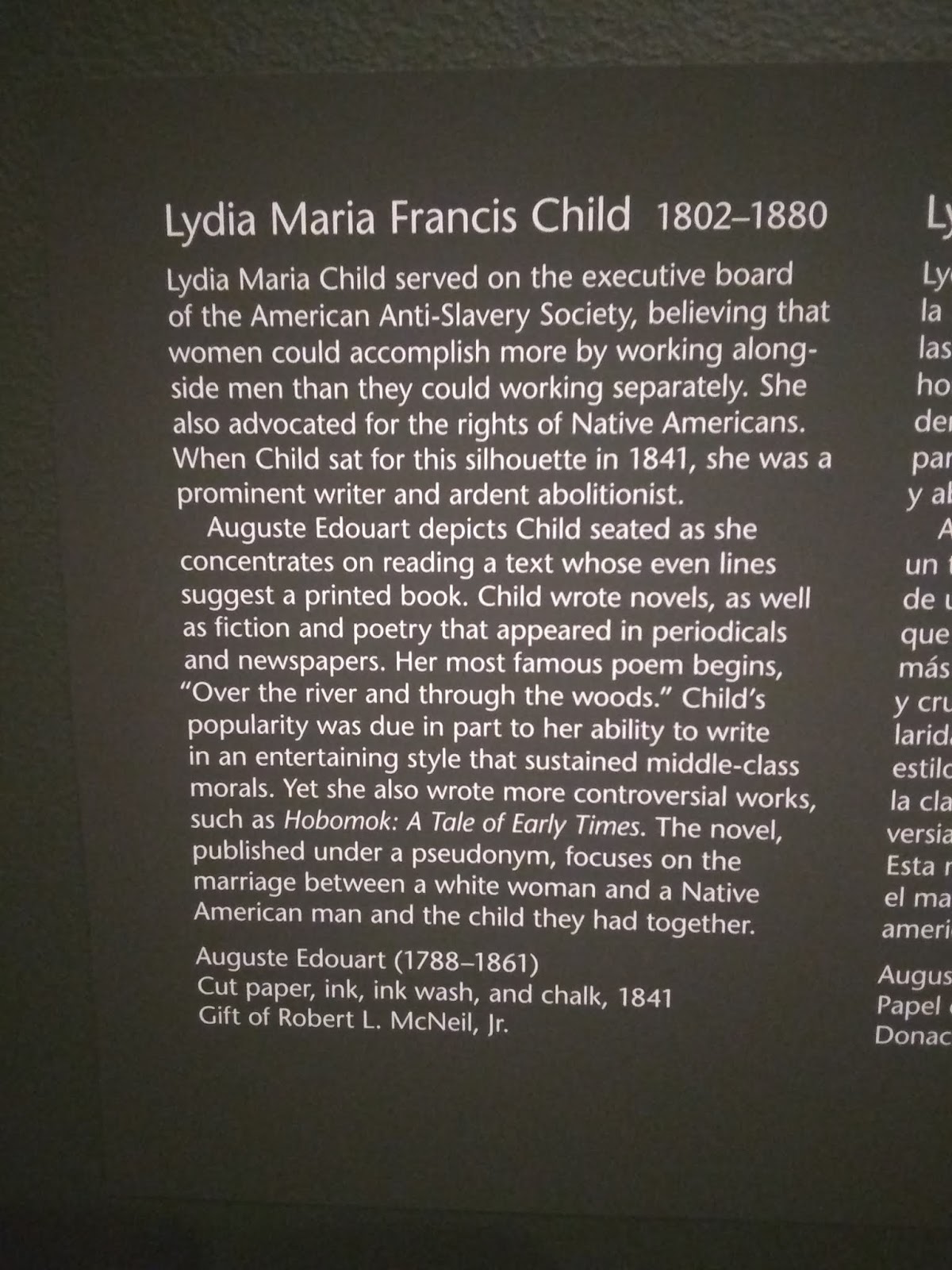
Lydia Maria Child--She deserves more attention in US history lessons.

Friday, May 17, 2019
Some sights while walking

For the unit on media in my Contemporary American Society class, I assign a poem by Emily Dickinson and some quotes.
"I'm Nobody! Who Are you?' (260)
Are you - Nobody - too?
Then there's a pair of us!
Dont tell! they'd advertise - you know!
How dreary - to be - Somebody!
How public - like a Frog -
To tell one's name - the livelong June -
To an admiring Bog!
One of the quotes:
"We are what we pretend to be, so we must be careful about what we pretend to be.” - Kurt Vonnegut Mother Night page vi
Below is a picture I took late last summer in DC along the Mall near the Smithsonian Castle. There were a lot more butterflies, but I couldn't get a good picture of a large group of them. One of my favorite walks anywhere is along that side of the Mall at sunset, so I wish I could find one of my pictures of red skies while looking toward the Washington Monument and Lincoln Memorial.

This was recently on a sidewalk in Madison along Midvale Boulevard, the route I often walk between my Madison apartment and the Sequoya Library.

Thursday, May 09, 2019
Exhibits of art by young people

One of my favorite types of art exhibits is art created by kids and teenagers, particularly at art museums. I think this is a great way to link art collections with doing art. Other ways are things like drawing lessons, which I often notice at the Walters in Baltimore.
The Madison Museum of Contemporary Art runs Young at Art every two years. I wonder why not more often since many people really enjoy this. None of the staff knew the answer when I asked them, so I'll email the museum.
We were allowed to take photos of the art. One of my favorites was the bear near the bottom left.

The ceramic work below was one of my favorites at this exhibit because of the messages it suggests and the look of it.


Below is a big piece.


Below is the section facing the sidewalk. The painting on the bottom right is of the Monona Terrace convention center designed by Frank Lloyd Wright and the state capitol.

Sunday, May 05, 2019
Buying toilet paper made from recycled paper
The Natural Resources Defense Council (NRDC) issued a report earlier this year--"The Issue With Tissue: How Americans Are Flushing Our Forests Down the Toilet"--calling on us to buy more environmentally friendly toilet paper and to tell the major manufacturers to switch to recycled paper. The report says that among the advantages of toilet paper made from recycled paper instead of virgin wood are that its production uses much less water and produces a lot less greenhouse gases. This also protects forests and the wildlife inhabiting them.
NRDC article discussing the report: "A Shopper’s Guide to Home Tissue Products" March 12, 2019
https://www.nrdc.org/stories/shoppers-guide-home-tissue-products (The image with grades is from this article.)

Link to NRDC report:
https://www.nrdc.org/sites/default/files/issue-tissue-how-americans-are-flushing-forests-down-toilet-report.pdf
I should have taken this more into consideration and promoted it long ago. The next time I'm in Gettysburg, I'll see how well the stores stock more environmentally friendly toilet paper.
 |
| Grocery store shelf in Madison, Wisconsin |
NRDC article discussing the report: "A Shopper’s Guide to Home Tissue Products" March 12, 2019
https://www.nrdc.org/stories/shoppers-guide-home-tissue-products (The image with grades is from this article.)
Link to NRDC report:
https://www.nrdc.org/sites/default/files/issue-tissue-how-americans-are-flushing-forests-down-toilet-report.pdf
I should have taken this more into consideration and promoted it long ago. The next time I'm in Gettysburg, I'll see how well the stores stock more environmentally friendly toilet paper.
Tuesday, April 23, 2019
Climate Change: Information Statement of the American Meteorological Society
Adopted by the American Meteorological Society Council on April 15, 2019, issued on April 22. Its last statement on climate change was in 2012. The body of this statement is only a little more than five pages.
Web-page version
PDF version
A lot of news stories talk about people being scared of climate change. Reading this kind of thing is more likely to anger me because of failure to be more responsible.
Excerpts:
"Global temperatures were last on par with the present ones in the previous Interglacial Period (125,000 years ago), when sea level was 6–9 m (20–30 ft) higher than today. Projected warming over the next century will likely place global temperatures in a range not seen in millions of years of geologic history." Page 1
"In addition to the widespread warming, the oceans are becoming more acidic and the amount of dissolved oxygen is decreasing, impacting marine life. These changes are consequences of well-understood chemical and physical processes. Seawater becomes more acidic when it absorbs some of the excess carbon dioxide that has accumulated in the atmosphere. Observations show that the oceans have become 25% more acidic (0.1 pH decrease) over the last century. Ocean acidification affects marine organisms, notably those that build calcium carbonate structures, including shellfish, corals, and many species of marine plankton. Pervasive surface warming has led to reduced ocean oxygen levels that, when combined with coastal pollution, contribute to ocean 'dead zones' and massive fish kills. An increase in the magnitude and duration of ocean temperature extremes represent an acute near-term threat to many marine ecosystems, including coral reefs, as apparent from the global-scale coral bleaching event of 2015–2016." Page 2
This is what Senator Gaylord Nelson, the founder of Earth Day, said in a speech during the first Earth Day on April 22, 1970:
"Our goal is not just an environment of clean air and water and scenic beauty. The objective is an environment of decency, quality and mutual respect for all other human beings and all other living creatures.
Our goal is a new American ethic that sets new standards for progress, emphasizing human dignity and well being rather than an endless parade of technology that produces more gadgets, more waste, more pollution.
Are we able to meet the challenge?
Yes. We have the technology and the resources.
Are we willing? That is the unanswered question."
From text of speech Denver, CO, April 22, 1970
Wednesday, April 17, 2019
Frida Kahlo: "Still Life: Pitahayas" (1938) at the Madison Museum of Contemporary Art

"It is fuchsia on the outside and hides the subtlety of a whitish-gray pulp flecked with little black spots that are its seeds inside. This is a wonder! Fruits are like flowers: they speak to us in provocative language and teach us things that are hidden.” Frida Kahlo on this painting
"Still Life: Pitahayas" was back on display at the Madison Museum of Contemporary Art until February 3, 2019. I think fewer than 20 US museums have her art in their collections. The museum lacks galleries to permanently display art that it owns, which disappoints me. I wonder what pitahayas taste like.

"Pitahayas: more than a still life–a self-portrait of Frida Kahlo"
https://artsandculture.google.com/exhibit/TwJCvMnyaXG2LQ


This recent episode of the BBC's The Forum--"Frida Kahlo: A Life in Colour"--is a helpful discussion among leading experts on Kahlo. https://www.bbc.co.uk/radio/play/w3cswpsl [44 minutes]
Website with images of paintings mentioned in this show:
https://www.fridakahlo.org/
I took the above pictures this past winter. Last month I visited the National Museum of Women in the Arts, which is in DC. Frida Kahlo's self-portrait there:


By the way, an interesting quotation floating online seems to be incorrectly attributed to Frida Kahlo:
"I used to think I was the strangest person in the world but then I thought, there are so many people in the world, there must be someone just like me who feels bizarre and flawed in the same ways I do.
I would imagine her, and imagine that she must be out there thinking of me too.
well, I hope that if you are out there you read this and know that yes, it’s true I’m here, and I’m just as strange as you."
Someone asked Quote Investigator about the source. What possibly happened was that someone wrote this on a postcard with Kahlo's image. The card got posted online, and some assumed that the image of Kahlo meant she said it.
https://quoteinvestigator.com/tag/frida-kahlo/
Sunday, March 24, 2019
Hillside in Lawrence, Kansas

Lawrence Ferlinghetti--born March 24, 1919--still alive
From ending of "The Astonished Heart":
"There is a great crowded bluff
in Lawrence Kansas
that looks a long way
into the astonished heart
of America."
Published in "Open Eye, Open Heart" (1973) and "These Are My Rivers: New & Selected Poems 1955-1993" (1993)
The picture is during a graduation ceremony at the University of Kansas looking south from the football stadium to the side of Mount Oread. When I lived in the J. R. Pearson dorm, I often liked to walk across this area from the Union and nearby classroom buildings. Later on, I sometimes would buy a submarine sandwich from the Yellow Sub and sit on this hillside to look north at the valley where the Kansas River runs. This was especially great when someone was playing the carillon in the campanile. But I don't think I ever took a picture of that view. Most of the time I rarely I saw anyone else there.
There aren't many places in Lawrence that could be called a bluff. I think he meant somewhere on this large hill on which the heart of the campus sits or by the riverbanks. But I don't think the latter are high enough to be bluffs. I now wish I'd contacted him when he was younger to see if a specific site influenced him, maybe to place a small monument to poetry with this line or the entire poem inscribed on it.
Subscribe to:
Posts (Atom)