Sachs Covered Bridge; Adams County, PA

Sachs Covered Bridge; Adams County, PA
Showing posts with label University of Wisconsin. Show all posts

Monday, February 18, 2019

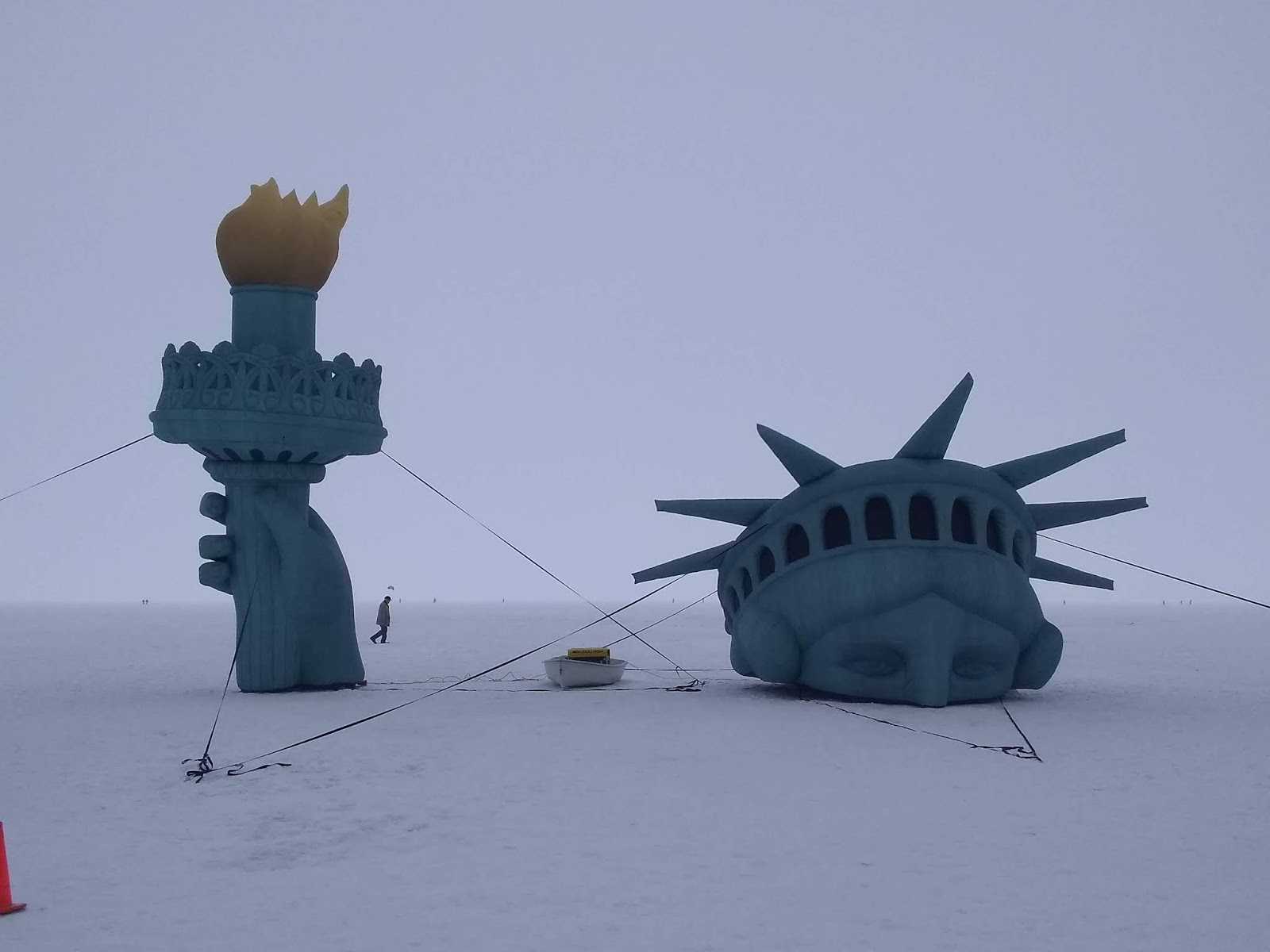
Statue of Liberty: Lake Mendota, Madison, Wisconsin, February 2, 2019

Photo taken from the University of Wisconsin Memorial Union Terrace


The only times that I've walked out on the ice is during an official event like this when experts check the safety. To the right of this was an ice fishing shack. 

Sunday, June 24, 2018

Sunset over Lake Mendota (Madison, Wisconsin)

This spring I saw these scenes one evening while walking from downtown back to my Madison apartment. A path runs from the Memorial Union on the University of Wisconsin campus to the university medical campus and Eagle Heights graduate student apartments, where I used to live. From there it is about a 45-minute walk to my Madison apartment in the Hilldale area.


Monday, February 05, 2018

Madison Food Carts--Avocado Spring Rolls

The main spots in Madison with food carts are at UW's Library Mall and around the Capitol Square during lunch time. I think food carts rather than food trucks are more common here because they can fit on the wide pedestrian spaces and walks at those two sites.  According to the city's Food Cart & Food Vending Guidelines, "Full service food trucks may operate in Madison only at special events and/or if licensed to vend in City of Madison parks. The maximum size for a Mall / Concourse food cart is 56 square feet. Elsewhere in Madison, the maximum size for a food cart is 10 feet by 12 feet. The maximum height for a food cart is 10 feet."

Some related articles:


Because I almost always eat at home or stuff I bring from there, I rarely eat at food carts. One of my favorites when I do try one is the huge avocado spring roll sold for $3 by Luang Prabang on Library Mall. 


During warm weather, food carts and trucks can also set up at some recreation sites in neighborhoods throughout the city, such as by a soccer field north of Sequoya Library early on Tuesday evenings.


Monday, November 06, 2017

John Muir's wooden Clock-Desk in lobby of Wisconsin Historical Society (University of Wisconsin-Madison campus)

I wish that I'd looked into this more while a grad student at UW. John Muir, the environmentalist who is often called the "Father of the National Parks," used this clock-desk to study while an undergrad at the University of Wisconsin. A slotted box under the toothed wheel contained books. After the time he'd set for studying a book, it would be returned to a slot and another get pushed up. The front legs are shaped like compasses for drawing circles and the back legs like stacked books. This device apparently connected to his "wide-awake bed," which would tilt him up and light a lamp as a sort of alarm clock. But other sources seem to describe the "wide-awake bed" and clock-desk as separate. Visitors to Muir's dorm room say he let them try out the bed. Muir describes the clock-desk in "The Story of My Boyhood and Youth" (1913): "I invented a desk in which the books I had to study were arranged in order at the beginning of each term. I also made a bed which set me on my feet every morning at the hour determined on, and in dark winter mornings just as the bed set me on the floor it lighted a lamp. Then, after the minutes allowed for dressing had elapsed, a click was heard and the first book to be studied was pushed up from a rack below the top of the desk, thrown open, and allowed to remain there the number of minutes required. Then the machinery closed the book and allowed it to drop back into its stall, then moved the rack forward and threw up the next in order, and so on, all the day being divided according to the times of recitation, and time required and allotted to each study."

More info: Blessing, Matt. "'The inventions, though of little importance, opened all doors for me': John Muir's Years as an Inventor". Wisconsin Magazine of History, vol. 99, no. 4 (Summer 2016): 16-27. http://content.wisconsinhistory.org/cdm/ref/collection/wmh/id/52346 After Muir's death the family donated the unassembled clock-desk to the state. Library staff used a simple drawing of it to put it back together, but some parts seemed to be missing. I wonder if anyone has tried to create a working replica.


North Hall--where John Muir lived while at the University of Wisconsin in the 1860s. It now houses the political science department.
Wisconsin Historical Society:
Main entrance--The clock-desk is in the lobby after turning right.


Sunday, August 27, 2017

Sociology Research Methods Syllabus

Here's a syllabus for one of the semesters, Spring 2006, that I taught Methods of Sociological Inquiry at the University of Wisconsin-Madison. I used to post teaching and research materials on UW's website but didn't move those after I left. In the future, I'll re-create it, but I will post this syllabus for now in case someone is searching for some teaching ideas. Many of the links are no longer OK. (Not all of this is aligning correctly, so I'll try to fix it later.)

My version seems to be more hands-on with a variety of research activities and includes lots more historical examples, such as from The Philadelphia Negro by Du Bois because of his use of systematic observation and interviews in the study of race. Many of the readings in my sections of research methods ended up examining the topics of race and order using different methods. In addition to Du Bois on race, Duneier used mainly participant observation but also interviews, conversation analysis, a simple field experiment, and historical research. LaPiere ran a famous field experiment in the 1920s followed by a questionnaire, and there are the field experiments by Pager (black and white men, with and without criminal records, applying for jobs) and by Massey and Lundy (undergrads at Penn calling landlords about apartments).This Spring 2006 syllabus has less on order than what I assigned in previous semesters. That topic pops up in Du Bois, Duneier, as well as Zimbardo on street vandalism.


Sociology 357—Methods of Sociological Inquiry
Spring 2006, the University of Wisconsin-Madison

Lecturer: Chuck Ditzler

Office 7105 Social Science Building             Office Hours: Tuesday 11am-noon,
Office Phone:   262-7458                               Thursday 11am-noon, or by appointment
Email: cditzler@ssc.wisc.edu

Class Scheduled: TR   9:30am-10:45am        Class Location: 6232 Social Science Bldg.

Course Description
This is a hands-on course that introduces methods of sociological research. Two themes thread throughout much of this version of the course: recognizing facts inconvenient for one’s position and developing one’s imagination or ways of perception in research. 

The primary task of a useful teacher is to teach his students to recognize “inconvenient” facts—I mean facts that are inconvenient for their party opinions. And for every party opinion there are facts that are extremely inconvenient, for my own opinion no less than for others. I believe the teacher accomplishes more than a mere intellectual task if he compels his audience to accustom itself to the existence of such facts. I would be so immodest as even to apply the expression “moral achievement,” though perhaps this may sound too grandiose for something that should go without saying.  Max Weber “Science as a Vocation”

Shams and delusions are esteemed for soundest truth, while reality is fabulous. If men would steadily observe realities only, and not allow themselves to be deluded, life, to compare it with such things as we know, would be like a fairy tale and the Arabian Nights’ Entertainments.  Henry David Thoreau “Where I Lived and What I Lived For” Walden

From the Undergraduate Catalog, 2003-2005:
357 Methods of Sociological Inquiry. (Crosslisted with Rur Soc) I or II or SS; 3-4 cr (I). Scientific methods and their application in the analysis of society; procedures in testing sociological theory: problem definition, hypothesis construction, collection and evaluation of data. P: So st; not open to stdts who have taken Soc 358.

Monday, April 24, 2017

Seen or Heard?: Art and Stopping Human Trafficking (Outdoor Display at UW-Madison in April 2016)

To what extent do people look at and are influenced by such displays? At least the creators and those directly affected might feel from these some kind of accomplishment, some kind of psychological help. But would those not already on board notice and take concrete steps? I suppose the accumulative effects of such efforts help the messages sink in. I wonder if a lingering student thought through this and decided to become an activist or an intern at the capitol was motivated to mention human trafficking to a legislator.

"...intentionally being shown outdoors so that it mimics the fact that trafficking exists all around us, hidden in plain sight."
Last April, from the 4th through the 25th, a photographic display on human trafficking--"Bought and Sold: Voices of Human Trafficking" by Kay Chernush--was placed in the mall that runs between the two halves of the Chazen Art Museum. It's a busy zone for students to walk between bus stops/dorms and the libraries/Memorial Union, so I hope many at least glanced at these to consider the problem. This coming week is a unit in my online classes on art, music, and animals in society, and I'm including these photos to help illustrate this use of art.

The photos with short captions are at the ArtWorks for Freedom website: 

Isthmus article: http://isthmus.com/events/kay-chernush/

To the left and right are the two halves of the Chazen; above and behind is the bridge connecting the two.


This one particularly drew my attention because of the idea of using a mask to survive. I'd add that those who kidnap, rape, and abuse wear "masks" to instigate these crimes and to fool themselves about their cruelty towards others.

The following display of paper cranes was placed in the Madison Public Library's Central Branch last April to observe Sexual Assault Awareness Month. One of my concerns is that these efforts risk being magical thought, which might serve some purposes, such as stress-reduction, but has little, if any, impact. I suppose this type of display is much more than magical thought and can work to convey the message. This is near where children with their parents might walk by to reach the children's books area, so maybe some asked about these and parents possibly discussed the topic of sexual assault and abuse.


Sunday, February 22, 2015

Madison's Annual International Festival, Overture Center--February 21, 2015

Around this time every year is the International Festival at the Overture Center, with free performances of music and dance from throughout the world, mainly locally based groups from or inspired by such places as Ghana, Bulgaria, Mali, Brazil, Russia, China, and Mexico. The festival begins with two guys playing long alphorns in the lobby. This year I managed to hear them after I'd made quick visits to the nearby library and the winter farmers' market. Some local organizations sell ethnic foods that I think cost too much, around $8 for small platefuls. I tried what was labeled as Caribbean taco, which wasn't so good because of the poor quality tortilla, and then a cup of cannoli cake.

One of my favorite things to do at the festival is to talk with representatives of the Returned Peace Corps Volunteers of Madison at their table. I like to ask about their experiences and then pick up literature to share with my students.

I only attended two major performances this year: the UW Russian Folk Orchestra and most of the acts put on by the Madison Chinese Cultural Association. The Russian music was beautiful, especially one piece with a flute soloist. The Chinese acts began with a group of guzheng musicians accompanied by an erhu and (I think) a dizi. While looking over the list of types of  music, I now wish that I'd stuck around longer or returned to hear more. [The schedule of performances is available through the Festival's web page.]

photo of Overture Hall International Festival UW Russian Folk Orchestra
UW Russian Folk Orchestra, Madison's International Festival, February 21, 2015 in the Overture Hall
An advantage of living in Madison is to see and hear different kinds of musical instruments being played. Every spring the UW Javanese Gamelan Ensemble performs for free on campus. Soon after Christmas the Madison Marimba Quartet also performs for free, but I missed the most recent show.

Saturday, June 18, 2011

Christmas Ornament House
On the weekend of June 10-11, I attended some of the Marquette Waterside Festival, which is held at a narrow park along Lake Monona. Scheduled for Saturday were mainly international or ethnic music acts. These especially interested me because I like both kinds, but I preferred hearing the sitar act that was scheduled. Food and beer vendors help fund these neighborhood festivals, and some organizations set up booths, such as on protecting WI riverways, the Sierra Club, Amnesty International, and WORT (the community radio station). What most attracted my attention were UW astrobiologists, with microscopes to look at tiny meteorite particles that they explain you can find at home. They also handed out cards on life forms that live in extreme conditions on Earth.

One of the nearby houses has a tree with year-long Christmas ornaments. When I first saw this, I asked the owner about the weather breaking the ornaments, but she said the main problem was squirrels knocking down the balls and even chewing them, especially red balls. Below is a 3D photo of one of the ornaments.


Friday, April 29, 2011

Authentic Chinese food--an example 西红柿炒鸡蛋 (stir-fried tomatoes and eggs)
The only food critic to win a Pulitzer, Jonathan Gold of the LA Weekly, delivered a lecture last night titled "Authenticity, Culture, and the Korean Taco" as part of the Humanities Without Boundaries series of UW. During the last half, Gold used his cell phone as a miniature teleprompter to read some of his talk. The best part was in Q and A, such as when he was asked about the worst meal he'd ever eaten.

The issue of whether a dish is authentic reminds me of one of the most common dishes in Chinese homes--tomato and eggs.  In my experience, this can be a main or side dish at any meal, but I've yet to notice it at a typical Chinese restaurant in the US.

Whenever I taught oral English, one of my assignments was to ask students to describe how to cook a dish, and I think that the majority chose tomato and eggs. It basically entails cooking scrambled eggs in some vegetable oil-- sort of into an omelet but then cut into pieces with a spatula. You then cook the tomatoes--either diced (my preference) or in wedges--usually with green onion or scallion and maybe some ginger, although this could overpower the other flavors. Finish by mixing together the cooked eggs and tomatoes. Salt is almost always added at some point, and a little bit of sugar is OK, although not so common.

By the way, another common dish I've had in Chinese homes was uncooked sliced tomatoes with sugar sprinkled on top.

Many of the online recipes seem to call for too many tomatoes, even one for every egg; however, I--and most of the Chinese I've talked to about this--use one regular-size tomato with two or three eggs.

A lot of variations
1. mix with noodles or even rice
2. with garlic (I think that green onions are much more commonly used.)
http://www.beijingmadeeasy.com/chinese-recipes/egg-and-tomato-chinese-recipe

3. with some sugar
http://appetiteforchina.com/recipes/stir-fried-tomato-eggs

4. close to what I describe
http://www.travelchinaguide.com/tour/food/chinese-cooking/scrambled-eggs-tomato.htm

http://www.epicurious.com/recipes/food/views/Stir-Fried-Egg-and-Tomato-352835

Videos
This one has too many variations from the norm
http://www.youtube.com/watch?v=FRfLNGE2YUo [I think her tomato wedges are too big and she cooks this longer than necessary. Adding chicken flavoring is definitely not typical. I don't push the spatula so much while the tomatoes cook, and mine is not so wet or juicy. Pushing the cooked eggs to the side of the pan while cooking the tomatoes, as she does it, is fine rather than emptying them into a bowl.

At the end she mentions dipping bread into the juices. I think that this would only be good with the very dry mantou (steamed buns) that are common in northern China.]

Wednesday, December 08, 2010

Go Big Read and A Sand County Almanac?
Yesterday, I nominated Aldo Leopold's A Sand County Almanac, first published in 1949, to be the book for next year's Go Big Read, UW's version of the all-campus/community/common book read. In the first year, 2009, the book was Michael Pollan's In Defense of Food, and this fall it was Rebecca Skloot's The Immortal Life of Henrietta Lacks.
the Leopold "shack," north of Baraboo, WI, along the Wisconsin River 
[This stereophoto reveals some of the problems with using my cheap camera. One is that the mirrors sometimes create a reflection in the picture--in this case, on the birdhouse in the left image and a little bit on the top center of both images.]

I have some mixed feelings about my nomination. It's a cliche to associate the university and the state with  A Sand County Almanac because he was a UW professor and the "almanac" section focuses on what can happen during a calendar year at "the shack," just north of Baraboo and along the Wisconsin River. Another thing is that many here have probably already read the book. However, Go Big Read seems tailored to undergrads, particularly freshmen, most of whom haven't read it.

The biggest reasons in favor of this selection are that this could be the last chance to enable many people to hear first-hand from the author's surviving children--Nina Leopold Bradley (b. 1917) and Estella Leopold (b. 1927)--about their lives at the shack, their father, and his ideas.

Thursday, October 21, 2010

Watching films and Errol Morris
This evening's talk by Errol Morris, the director, was among the best I've heard at the Union Theater, and I was glad that I could tell him that at the reception. After talking for about 20 minutes, mainly on his time at UW as a history major, he opened it up to questions, which lasted for about one hour. It was a good way for audience members to ask about various films and for him to then provide interesting and often humorous background info. Because The Thin Blue Line is one of the options for my documentary assignment, I mentioned the lecture to my criminology students, but during the talk I regretted not more strongly encouraging people to go. I'll be sure to be there early for the showing of his recent film Friday afternoon at the contemporary art museum, at which he'll also be present.

While at UW, Morris often watched on his own films in the historical library collection. This reminds me of my time at Kansas going to the union to watch movies, such as The Seventh Seal, The Bicycle Thief, and The 400 Blows. I once told someone that I was going to the movie so as to study, and I wonder if he thought I was joking. I wasn't.

This evening Morris said that a great interest of his is the inner mystery of people, of others as well as oneself. Films, like novels, can sometimes offer insights into life's meaning, even when the characters lead lives different from mine. The first movie that comes to my mind that hits home, though, I'm reluctant to say much about--the John Malkovich/Joanne Woodward/Karen Allen version of The Glass Menagerie. One scene in particular reminds me of my own experiences.

Since it's really a play, I wonder about classifying The Glass Menagerie as a movie. The version I mention is much better, I think, than the one with Katharine Hepburn. Anyway, it has one of the best movie lines--"Time is the longest distance between two places." One message of this is regret about past actions and inactions. I've been thinking about how I've sometimes let my fear of re-experiencing something like The Glass Menagerie scene and other painful moments to influence me at times, especially in recent months. This is one of the values of films--to help us reflect on our inner selves and those of others. But meeting people in person should remain the main way that we accomplish this. One reason that I enjoyed this evening's talk and the reception was seeing Morris' cheerful and inquisitive disposition.

Monday, August 30, 2010

Textbook costs
Too many textbooks cost about as much as I pay for food each month. In some fields, teachers have few, if any, alternatives, but I don't think that's the case in the social sciences. A lot of useful outside materials are freely available online. For criminology I can assign, among many things, short DOJ reports and public radio audio clips.

This semester I've assigned two required books: Cry Rape: The True Story of One Woman’s Harrowing Quest for Justice and Cop in the Hood: My Year Policing Baltimore's Eastern District. Because Cry Rape is about a Madison case written by an area reporter, more than 30 copies are in the local libraries. Last semester, my students talked for around one hour about the book without my saying much, except to choose sometimes who would talk next. Besides the crime of rape, it covers the perspective of victims and police mistakes, such as tunnel-vision and overgeneralization. But I worried that my students got too negative of an angle on the police, so this semester I've also chosen Cop in the Hood, by a sociologist who joined the Baltimore police. Much of the book is his take on illegal drugs, so the book serves more than one purpose. Students must also pick from a list a third book to borrow from the library to learn about a topic that interests them.

When I taught research methods at UW-Madison, I was able to assign an older edition that the bookstore sold for $15-20. The small improvements in the newest edition were definitely not worth the more than $80. I got this idea from a UW professor, and I wish that others would try it so that books are used more while they still are in OK shape and students can save money. Online textbooks might be a relatively inexpensive path, but the main response to outrageous prices is for teachers to force textbook writers to use cheaper publishers or even create their own textbooks. If I'd had access to the Web in China, I could have edited my own casebook for contract law using public domain court opinions. Why more law professors don't do this disappoints me, especially given their enormous salaries.

Sunday, August 08, 2010

Worrying about groceries
I’ve had mixed feelings about posting the following story because it feels like a kind of boasting; however, I think that people who know me would be disappointed if I didn’t tell them about this short encounter.

One evening in fall 1996, while I was living in Chicago’s Hyde Park neighborhood, I was carrying a heavy paper bag of groceries and, in my backpack, a gallon of milk and other heavy items as I walked back to the apartment. Along 53rd Street some guy was handing out fliers. He said he was running for the state senate, so I decided to stop and talk with him--in part so as inform myself before voting but also because I felt alone in Chicago. Most people don't pay attention to such candidates, so another reason that I stopped is because I felt sorry for him.

With my arms wrapped around the grocery bag, I skimmed through his flier and noticed that he had been the president of the Harvard Law Review. I began talking with him about my experiences teaching law in China, such as that I used the ideas from Plain English for Lawyers, and about how I was from Kansas and had attended law school there so as not to go into debt. Otherwise, I would have been unable to teach in China while earning less than $300/month and having to pay back loans. He was one of the few people after my return who was interested in talking with me about China. After we had talked about various topics, I said that I'd definitely vote for him and that I was giving back the flier to save him some money. My bag was getting heavy--I didn’t want to risk putting it on the ground out of fear that it would tear--and I had to put some things in the refrigerator.

But, as I was leaving, Obama said, "Wait, I'd like to talk to you about something!" I replied that I had to put some groceries in the refrigerator and that my bag was getting heavy. As I walked further away, he shouted to me that he wanted to talk to me about something, and I repeated what I had said about my groceries. I think that Obama one more time yelled that he wanted to talk to me about something.

I want to emphasize here that it never crossed my mind that Obama was being impolite for pressing me; my impression was that he was a nice guy, but I was puzzled over why he didn’t seem to process what I'd said. Later on, I realized how stupid it was of me not to wait another minute or two.

Before the 2008 Wisconsin primary, over 15 thousand people showed up for the Obama campaign rally in the Kohl Center at UW-Madison. I just managed to get a seat, and as I looked at the crowd, I sometimes laughed to myself about once feeling sorry for how few people were paying attention to Obama. Throughout the campaign, I kept wondering what he so urgently wanted to talk to me about in 1996. It was about a year later that the reason came to me, but I think it's best that I not post anything about it in this blog.