In recent years I've been focusing more on the environment and child sexual abuse. This week while reading Betrayal: The Crisis in the Catholic Church, a book by the Boston Globe about its Spotlight investigation on child sexual abuse, I've been reminded more strongly that central to both problems are outrageous failures to act on obvious evidence that simple steps must be taken. Not acting as soon as possible made matters much worse. This past December I felt similar shock and even anger about this while reading a good summary of climate change published by Oxford University Press--Climate Change: What Everyone Needs to Know, by Joseph Romm. It was the 2014 first edition, so his discussion about how climate change increases the likelihood of wildfires in California exasperated me.
Climate change and my own health have combined to motivate me since I was an undergrad to walk to reach places. I've nearly always lived within less than a twenty-minute walk of at least one grocery store. In this century, in places like Gettysburg, Madison, and Baltimore, it's usually been at least two grocery stores, which is great for taking advantage of sales.
My concern about child sexual abuse has increased while thinking about what to cover in criminology and intro sociology classes I teach, after learning about Adverse Childhood Experiences research, and when people have confided to me about this happening to them. Many of my students have told me that they'd learned nothing or very little about this before. I wish that I'd known years earlier about the extent and harms of child sexual abuse. Another thing I have been doing is contacting legislators and the news media to get more done. A couple of examples are to enact Erin's Law to teach about sex abuse prevention K though 12 and for public radio talk programs to do shows on the topic. I'd thought that sending letters glued into greeting cards would more likely get attention and action, but I'm very disappointed that I got almost no response. Because of the renewed attention to child sexual abuse in recent months, I'm trying again. I suppose people who were abused would feel a lot worse if they got no response.
Sachs Covered Bridge; Adams County, PA

Sachs Covered Bridge; Adams County, PA
Thursday, March 21, 2019

Monday, March 04, 2019
Mildred Thompson and Abstract Art


While Mildred Thompson was alive, she didn't get as much appreciation as she deserved. According to a tour guide yesterday at the National Museum of Women in the Arts, someone once suggested to her to recruit a white woman to stand in her place so as to increase the chances of selling her art.
Her official website:
Her art contributed the name of an exhibit held at the museum from October 13, 2017 through January 21, 2018--Magnetic Fields: Expanding American Abstraction, 1960 to Today. I wish I'd seen it.

She also worked with wood:


Friday, February 22, 2019
Monday, February 18, 2019
Statue of Liberty: Lake Mendota, Madison, Wisconsin, February 2, 2019
 |
| Photo taken from the University of Wisconsin Memorial Union Terrace |
History of Madison's Statue of Liberty https://news.wisc.edu/history-of-lady-liberty-on-lake-mendota/
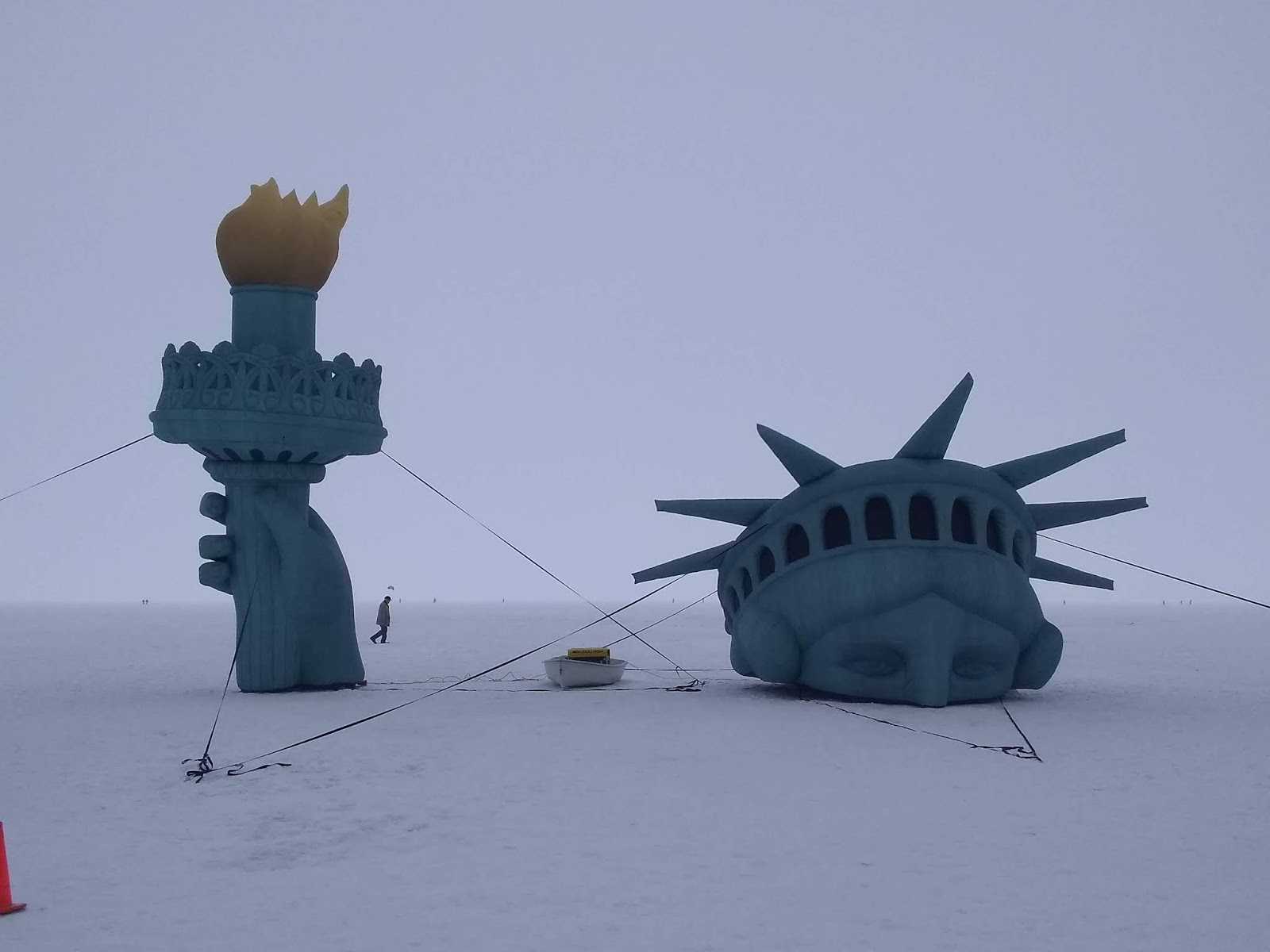 |
| The only times that I've walked out on the ice is during an official event like this when experts check the safety. To the right of this was an ice fishing shack. |
Monday, February 04, 2019
a song
"Far Off, Close By" (1968) by Willis Conover and Alec Wilder:
I first heard this song in China while listening to a VOA special on Willis Conover.
Monday, January 28, 2019
Colorful tables at National Gallery of Art and Baltimore Museum of Art

Whenever I enter or exit the National Gallery of Art's main building, I sometimes walk by this table near the west entrance. I very much like the colorful marbles on the top. I think it would be neat to try to make something like the top but with more affordable materials.


The Baltimore Museum of Art has the other one of this pair.

Saturday, January 26, 2019
Climate Change
 |
| In Harwood Community Garden, southwest corner of Whitridge and Greenmount Avenue, Baltimore (The garden is briefly discussed in this 2018 article: "What’s Growing in Baltimore? Community Gardens!") |
I like this perspective from environmentalist Paul Hawken:
"The single most important thing to do about reversing global warming is to recognize there is no one single thing, that addressing global warming is a way of seeing the world, a way of being in the world, a pathway to understanding that human systems created the problem and thus the cure is within the whole of the system. The most impactful act an individual can do will depend on that person’s life, knowledge, community, influence, relationships, courage. It will be different for everyone. Together, we act and make a difference. It is not about what 'I' can do. It is about what we can do. Carbon is an atom (and molecule) that holds hands and collaborates. That is what global warming is telling us to do.” From "16 Sustainability Leaders Weigh In: How YOU Can Help To Reverse Global Warming"
While I was teaching in China, I was so immersed in living there but losing touch with life in the US that in 1994 I decided to go to the English-language room of the Beijing National Library and read Al Gore's Earth in the Balance. So much has changed in China since then. I usually felt happy there from spending time with my students and Chinese colleagues. I have too many thoughts about that time and my life now.
"--for time is the longest distance between two places." Tom in The Glass Menagerie by Tennessee Williams. I'm quoting Tom, but I more often feel like what his sister felt. That's one reason why going to China was one of my best decisions.
Sunday, January 13, 2019
"Due to too much snow, we have cancelled the Snow Show this afternoon."
A few weeks ago I learned about a special event on snow that was going to be held today at the Natural History Society of Maryland. I was thinking about going because it seemed really interesting.
From the event announcement:
"At this Nature Connections we will be taking an in-depth look at snow and learning all about how Wilson “Snowflake” Bentley took his 1885 iconic snowflake photographs. Martin Schmidt will demonstrate how snow forms in the atmosphere and grows into storms. And in a special presentation, Kathy Hrechka will be showing us her approach of photographing snow with a process called photomicrography."
But it has snowed so much in the area this weekend that they had to cancel it.
Website on Wilson Bentley:
Wednesday, December 26, 2018
"The Druid"--tree stump sculpture in Baltimore's Druid Hill Park

On March 26, 2017, I posted about the "Green Man" tree stump sculpture in Druid Hill Park. It slipped my mind to post pictures of the other one in the park by Marc Acton, "The Druid," which sits on a hill north of the park's reservoir. I took these in February 2018. The reservoir is being worked on, so I haven't gone through this area recently. I like the feeling of this setting when the leaves are gone but it's not that cold. For more on the tree carvings, you can read this December 20, 2012, article in the Baltimore Sun, "Dead trees in Druid Hill Park are carved into sculptures."

A little east of this spot is the Latrobe Pavilion, which was a built around 1860, according to a site on engineering in Baltimore. I like the yellow, green, and red colors.

Saturday, December 08, 2018
I very much hope that she'll contact me, maybe by email or a comment to this or another post. I loved getting to know about her by reading her blog and looking at her website before she took them down. I'm very unhappy with myself for not doing things differently.
Monday, September 17, 2018
Judith Leyster "Self Portrait" at the National Gallery of Art in DC
Whenever I visit the National Gallery of Art, I usually try to look at my favorites. One of them is Judith Leyster's "Self Portrait," from about 1630, because I like her relaxed mood.

I learned from a video about this painting [4 min 34 sec] that underneath the fiddler is probably another self-portrait. The clothing in this is too unsuitable for her to wear while painting, so I think it would have been neat if the painting within the painting was of her wearing what she'd normally have on while painting. Something like the reverse of what Norman Rockwell created with his "Triple Self-Portrait."
Wikipedia entry on Judith Leyster: https://en.wikipedia.org/wiki/Judith_Leyster
--------------------------
Added on November 29, 2018. This is a closer view, taken where the painting is usually hung with the other Dutch paintings on wood wall panneling. I think the colors in this picture are closer to what I see in person.


I learned from a video about this painting [4 min 34 sec] that underneath the fiddler is probably another self-portrait. The clothing in this is too unsuitable for her to wear while painting, so I think it would have been neat if the painting within the painting was of her wearing what she'd normally have on while painting. Something like the reverse of what Norman Rockwell created with his "Triple Self-Portrait."
Wikipedia entry on Judith Leyster: https://en.wikipedia.org/wiki/Judith_Leyster
--------------------------
Added on November 29, 2018. This is a closer view, taken where the painting is usually hung with the other Dutch paintings on wood wall panneling. I think the colors in this picture are closer to what I see in person.

Monday, September 03, 2018
Labor Day Weekends
This Labor Day weekend, it's been raining a lot. Ever since I was a kid I've associated this weekend in the year with watching the muscular dystrophy telethon hosted by Jerry Lewis while it's raining. I've rarely watched television during this century. The main times were when visiting my grandmother since she often watched it. I liked watching with her some of the telethon because it was similar to the variety shows common on broadcast television before the spread of cable.
Another thing I associate with Labor Day is the Willy Wonka and the Chocolate Factory movie after I saw it again while I was visiting home during my first semester in college. I especially think of when Gene Wilder sings "Pure Imagination" and the meaning of the lyrics. Writing this has given me the idea to play in my sociology classes a clip of Wilder singing the song and asking my students for their thoughts. The song is maybe too personal for me, so I have to think about whether to try.
Below is "Round Falls"--Dam on Jones Falls river in Baltimore, near the Jones Falls Trail where it follows Falls Road. Location is 2948 Falls Rd, Baltimore, MD 21211. The small trail down to this spot should be improved to make it safer and more accessible. I took this picture in July and include it here because I like the effect of the light rays into this spot.

Another thing I associate with Labor Day is the Willy Wonka and the Chocolate Factory movie after I saw it again while I was visiting home during my first semester in college. I especially think of when Gene Wilder sings "Pure Imagination" and the meaning of the lyrics. Writing this has given me the idea to play in my sociology classes a clip of Wilder singing the song and asking my students for their thoughts. The song is maybe too personal for me, so I have to think about whether to try.
Below is "Round Falls"--Dam on Jones Falls river in Baltimore, near the Jones Falls Trail where it follows Falls Road. Location is 2948 Falls Rd, Baltimore, MD 21211. The small trail down to this spot should be improved to make it safer and more accessible. I took this picture in July and include it here because I like the effect of the light rays into this spot.

Sunday, June 24, 2018
Sunset over Lake Mendota (Madison, Wisconsin)
This spring I saw these scenes one evening while walking from downtown back to my Madison apartment. A path runs from the Memorial Union on the University of Wisconsin campus to the university medical campus and Eagle Heights graduate student apartments, where I used to live. From there it is about a 45-minute walk to my Madison apartment in the Hilldale area.


Thursday, June 14, 2018
The Book Thing in Baltimore--Free Books
One of the more interesting places in Baltimore is this warehouse--The Book Thing--stocked with over 100 thousand donated books in the Abell neighborhood, which can also be considered part of the Charles Village neighborhood, and about a 15-minute walk east of the main Johns Hopkins University campus.

According a Baltimore Sun story, the Book Thing gives away 400,000 to 500,000 books per year. It is open on Saturdays and Sundays, 9 am to 5 pm.
1. The Book Thing website: http://bookthing.org/
2. "Up from the ashes: The Book Thing returns," Baltimore Sun, October 13, 2017: http://www.baltimoresun.com/features/baltimore-insider-blog/bs-fe-the-book-thing-reopens-20171012-story.html
3. "The Book Thing Bounces Back--A Baltimore literary institution gets reborn, thanks to the community," Baltimore Magazine, September 2017: https://www.baltimoremagazine.com/2017/9/19/the-book-thing-bounces-back
1. The Book Thing website: http://bookthing.org/
2. "Up from the ashes: The Book Thing returns," Baltimore Sun, October 13, 2017: http://www.baltimoresun.com/features/baltimore-insider-blog/bs-fe-the-book-thing-reopens-20171012-story.html
3. "The Book Thing Bounces Back--A Baltimore literary institution gets reborn, thanks to the community," Baltimore Magazine, September 2017: https://www.baltimoremagazine.com/2017/9/19/the-book-thing-bounces-back
 |
| Green Room, at front entrance. |

Whenever I go there, I mainly concentrate on getting books that I can use in my teaching or research but can't easily find elsewhere. I suppose that many people would worry that some would abuse this by trying to haul away thousands of books at one time, but I have never seen anyone take more than a reasonable number. As can be seen in this photo, the books are stamped with a Not for Resale, usually on a title page, which I hope that used book stores will see and adhere to. [Varieties of Police Behavior is a classic by the criminologist/political scientist James Q. Wilson. I sometimes teach criminology but have only read parts of it.]
The Book Thing is run by volunteers and donations. I've volunteered a little by stamping, boxing, and sorting books. I think that usually the equivalent of over 100 boxes of books are donated each week.
 |
| Map of The Book Thing |
Monday, February 05, 2018
Madison Food Carts--Avocado Spring Rolls

Some related articles:
"Food cart showdown: More than 60 carts vying for downtown vending spots" Isthmus November 2, 2017
"Cart czar: New street vending coordinator Meghan Blake-Horst sees a 'perfect storm' of opportunity" Isthmus February 9, 2017
"The city of Madison needs to embrace innovation in its food cart scene" Isthmus November 25, 2016.

Because I almost always eat at home or stuff I bring from there, I rarely eat at food carts. One of my favorites when I do try one is the huge avocado spring roll sold for $3 by Luang Prabang on Library Mall.


During warm weather, food carts and trucks can also set up at some recreation sites in neighborhoods throughout the city, such as by a soccer field north of Sequoya Library early on Tuesday evenings.


Thursday, December 14, 2017
Dollar (or less) Days at Baltimore attractions
This past weekend--December 9 and 10, 2017--I visited most of the attractions during the
 |
| National Great Blacks in Wax Museum-- I think Mary McLeod Bethune looked the most life-like. |
Babe Ruth Birthplace Museum
Geppi's Entertainment Museum
Jewish Museum of Maryland
Maryland Science Center
National Great Blacks in Wax Museum
Reginald F. Lewis Museum
Star-Spangled Banner Flag House
Top of the World (27th floor of pentagon-shaped building at the inner harbor with good views of the area)
Geppi's Entertainment Museum
Jewish Museum of Maryland
Maryland Science Center
National Great Blacks in Wax Museum
Reginald F. Lewis Museum
Star-Spangled Banner Flag House
Top of the World (27th floor of pentagon-shaped building at the inner harbor with good views of the area)
 |
| Star-Spangled Banner Flag House--The dog is a nut cracker operated by raising and lowering the tail with the nut in the mouth. I forget what the box on the right is for, maybe soap. |
I didn't have time to get to the Historic Ships in Baltimore (which I've seen before), National Aquarium, and Port Discovery Children’s Museum. The Aquarium had long lines. When I walked by on Sunday around 11 am, the line extended almost to the USS Constellation, but at least the employee said that all of those in line could get in. I encountered no waiting at any of the places I visited, which was information I was looking for earlier this fall.
 |
| Geppi's Entertainment Museum |
 |
| Geppi's Entertainment Museum-- When I was a kid I watched the re-runs of the black-and-white Lassie and the color-version when she was on her own. |
Dollar Days is especially great for families with little income. The Aquarium's usual prices are Adults: $39.95 and Children (3-11): $24.95. The Science Center's are Adults: $24.95 and Children (3-12): $18.95. So I will send thank you notes to the sponsors and participating sites.
 |
| Jewish Museum of Maryland--quotes from people who lived in surrounding Lombard Street neighborhood. |
I'm not sure how to rank these. From my perspective I suppose I'd place the Babe Ruth
 |
| Maryland Science Center-- Feet on the pad at this end, head on pad at top. After you lie down on the plastic, the employee raises the nails that go up through holes in the plastic layer. I could feel the points, but it doesn't hurt at all. |
 |
| In Reginald Lewis Museum |
I couldn't attend Dollar Days last year, when the Baltimore Streetcar Museum and the Maryland Historical Society (which was free) took part. According to a 2015 Baltimore Sun article, in that year the sites were the same except that also included were the Carroll Mansion/Phoenix Shot Tower and the Washington Monument (Baltimore's) but not the National Great Blacks in Wax Museum.
 |
| View of the USS Constellation from the Top of the World |
 |
| View of the harbor from the Top of the World. Pyramids at bottom left are the National Aquarium; hill to the right with trees on top is Federal Hill. |
Monday, November 06, 2017
John Muir's wooden Clock-Desk in lobby of Wisconsin Historical Society (University of Wisconsin-Madison campus)
 I wish that I'd looked into this more while a grad student at UW. John Muir, the environmentalist who is often called the "Father of the National Parks," used this clock-desk to study while an undergrad at the University of Wisconsin. A slotted box under the toothed wheel contained books. After the time he'd set for studying a book, it would be returned to a slot and another get pushed up. The front legs are shaped like compasses for drawing circles and the back legs like stacked books. This device apparently connected to his "wide-awake bed," which would tilt him up and light a lamp as a sort of alarm clock. But other sources seem to describe the "wide-awake bed" and clock-desk as separate. Visitors to Muir's dorm room say he let them try out the bed.
Muir describes the clock-desk in "The Story of My Boyhood and Youth" (1913):
"I invented a desk in which the books I had to study were arranged in order at the beginning of each term. I also made a bed which set me on my feet every morning at the hour determined on, and in dark winter mornings just as the bed set me on the floor it lighted a lamp. Then, after the minutes allowed for dressing had elapsed, a click was heard and the first book to be studied was pushed up from a rack below the top of the desk, thrown open, and allowed to remain there the number of minutes required. Then the machinery closed the book and allowed it to drop back into its stall, then moved the rack forward and threw up the next in order, and so on, all the day being divided according to the times of recitation, and time required and allotted to each study."
I wish that I'd looked into this more while a grad student at UW. John Muir, the environmentalist who is often called the "Father of the National Parks," used this clock-desk to study while an undergrad at the University of Wisconsin. A slotted box under the toothed wheel contained books. After the time he'd set for studying a book, it would be returned to a slot and another get pushed up. The front legs are shaped like compasses for drawing circles and the back legs like stacked books. This device apparently connected to his "wide-awake bed," which would tilt him up and light a lamp as a sort of alarm clock. But other sources seem to describe the "wide-awake bed" and clock-desk as separate. Visitors to Muir's dorm room say he let them try out the bed.
Muir describes the clock-desk in "The Story of My Boyhood and Youth" (1913):
"I invented a desk in which the books I had to study were arranged in order at the beginning of each term. I also made a bed which set me on my feet every morning at the hour determined on, and in dark winter mornings just as the bed set me on the floor it lighted a lamp. Then, after the minutes allowed for dressing had elapsed, a click was heard and the first book to be studied was pushed up from a rack below the top of the desk, thrown open, and allowed to remain there the number of minutes required. Then the machinery closed the book and allowed it to drop back into its stall, then moved the rack forward and threw up the next in order, and so on, all the day being divided according to the times of recitation, and time required and allotted to each study."
More info: Blessing, Matt. "'The inventions, though of little importance, opened all doors for me': John Muir's Years as an Inventor". Wisconsin Magazine of History, vol. 99, no. 4 (Summer 2016): 16-27. http://content.wisconsinhistory.org/cdm/ref/collection/wmh/id/52346
After Muir's death the family donated the unassembled clock-desk to the state. Library staff used a simple drawing of it to put it back together, but some parts seemed to be missing. I wonder if anyone has tried to create a working replica.


 |
| North Hall--where John Muir lived while at the University of Wisconsin in the 1860s. It now houses the political science department. |
 |
| Wisconsin Historical Society: Main entrance--The clock-desk is in the lobby after turning right. |
Sunday, August 27, 2017
Sociology Research Methods Syllabus
Here's a syllabus for one of the semesters, Spring 2006, that I taught Methods of Sociological Inquiry at the University of Wisconsin-Madison. I used to post teaching and research materials on UW's website but didn't move those after I left. In the future, I'll re-create it, but I will post this syllabus for now in case someone is searching for some teaching ideas. Many of the links are no longer OK. (Not all of this is aligning correctly, so I'll try to fix it later.)
My version seems to be more hands-on with a variety of research activities and includes lots more historical examples, such as from The Philadelphia Negro by Du Bois because of his use of systematic observation and interviews in the study of race. Many of the readings in my sections of research methods ended up examining the topics of race and order using different methods. In addition to Du Bois on race, Duneier used mainly participant observation but also interviews, conversation analysis, a simple field experiment, and historical research. LaPiere ran a famous field experiment in the 1920s followed by a questionnaire, and there are the field experiments by Pager (black and white men, with and without criminal records, applying for jobs) and by Massey and Lundy (undergrads at Penn calling landlords about apartments).This Spring 2006 syllabus has less on order than what I assigned in previous semesters. That topic pops up in Du Bois, Duneier, as well as Zimbardo on street vandalism.
My version seems to be more hands-on with a variety of research activities and includes lots more historical examples, such as from The Philadelphia Negro by Du Bois because of his use of systematic observation and interviews in the study of race. Many of the readings in my sections of research methods ended up examining the topics of race and order using different methods. In addition to Du Bois on race, Duneier used mainly participant observation but also interviews, conversation analysis, a simple field experiment, and historical research. LaPiere ran a famous field experiment in the 1920s followed by a questionnaire, and there are the field experiments by Pager (black and white men, with and without criminal records, applying for jobs) and by Massey and Lundy (undergrads at Penn calling landlords about apartments).This Spring 2006 syllabus has less on order than what I assigned in previous semesters. That topic pops up in Du Bois, Duneier, as well as Zimbardo on street vandalism.
Sociology 357—Methods of Sociological Inquiry
Spring 2006, the University of Wisconsin-Madison
Lecturer: Chuck
Ditzler
Office 7105 Social Science Building Office Hours: Tuesday 11am-noon,
Office Phone:
262-7458 Thursday
11am-noon, or by appointment
Email: cditzler@ssc.wisc.edu
Class Scheduled: TR 9:30am-10:45am Class Location: 6232 Social Science Bldg.
Course Description
This is a hands-on course that introduces methods of sociological
research. Two themes thread throughout much of this version of the course:
recognizing facts inconvenient for one’s position and developing one’s
imagination or ways of perception in research.
The primary task of a useful
teacher is to teach his students to recognize “inconvenient” facts—I mean facts
that are inconvenient for their party opinions. And for every party opinion
there are facts that are extremely inconvenient, for my own opinion no less
than for others. I believe the teacher accomplishes more than a mere
intellectual task if he compels his audience to accustom itself to the
existence of such facts. I would be so immodest as even to apply the expression
“moral achievement,” though perhaps this may sound too grandiose for something
that should go without saying. Max Weber
“Science as a Vocation”
Shams and delusions are esteemed
for soundest truth, while reality is fabulous. If men would steadily observe
realities only, and not allow themselves to be deluded, life, to compare it
with such things as we know, would be like a fairy tale and the Arabian Nights’
Entertainments. Henry David Thoreau
“Where I Lived and What I Lived For” Walden
From the Undergraduate
Catalog, 2003-2005:
357 Methods of Sociological Inquiry. (Crosslisted with Rur
Soc) I or II or SS; 3-4 cr (I). Scientific methods and their application in the
analysis of society; procedures in testing sociological theory: problem
definition, hypothesis construction, collection and evaluation of data. P: So
st; not open to stdts who have taken Soc 358.
Saturday, August 26, 2017
Seckel Pears
 Seckel pears are about two inches long and sweet. Even though their history stretches back to the 1700s in the Philadelphia area, they're not so common these days, probably because their size makes harvesting more costly for growers. Eating them seems easier, and the core is often so small that I can eat the whole thing except for the stem and the tiny end. They're my favorite pears, so I'm posting about them to encourage others to be on the look out for Seckel pears at farmers' markets and maybe to suggest that orchards grow these.
At the Dane County Farmers' Market in Madison, Wisconsin, Weston's Antique Apples sells them for maybe one Saturday in late August. I was lucky to be back this week to attend meetings and am trying to find out if any farmers sell these in the Baltimore/DC area.
For more information:
"The Pears of New York" by U. P. Hedrick published in 1921: https://archive.org/stream/pearsofnewyork00hedrrich#page/n7/mode/2up [Seckel appears starting on page 215.]

Subscribe to:
Posts (Atom)