Sachs Covered Bridge; Adams County, PA

Sachs Covered Bridge; Adams County, PA

Monday, May 22, 2017

Art Deco House in Baltimore

The colors and design of this house make me feel that I'm in a Dr. Seuss story or maybe a Beverly Cleary book. I'm thinking what it would be like to have one or two rooms in a home with colors like this--maybe an eating area for breakfast and lunch by the kitchen. I'm not sure what else. I'd prefer something more down-to-earth--brownish and white--for maybe most of the home. The colors make me feel that there are many sorts of wonderful possibilities, that life can be magical and fun.

The variety of tiles on this kitchen wall especially attracted me. I wonder how easy it would be to create this. Maybe left-overs or samples would make this a cheap project?

I visited this house in Baltimore on Saturday, May 20, during its open house on the market. Many other visitors were impressed, with some saying it is impractical. But I think practicality can include impact on one's mental states, so I suppose some of this could lead to cheerful thoughts. The rooms are rather small, though.

I'm not a fan of the furnishings, but I still think they're fascinating.

The original owners were inspired by art deco architecture in the Miami area when they built this in 1948. The heat is from hot water radiant floors.


The tall bamboo lines the property line to the south. I've never seen such tall bamboo in this part of the US.
(I now remember that I've seen very tall bamboo while walking behind the zoo in Druid Hill Park.)

Original owner painted this white, but the turquoise trim is the same.
Bay window to left is living room; one to the right is the bedroom.
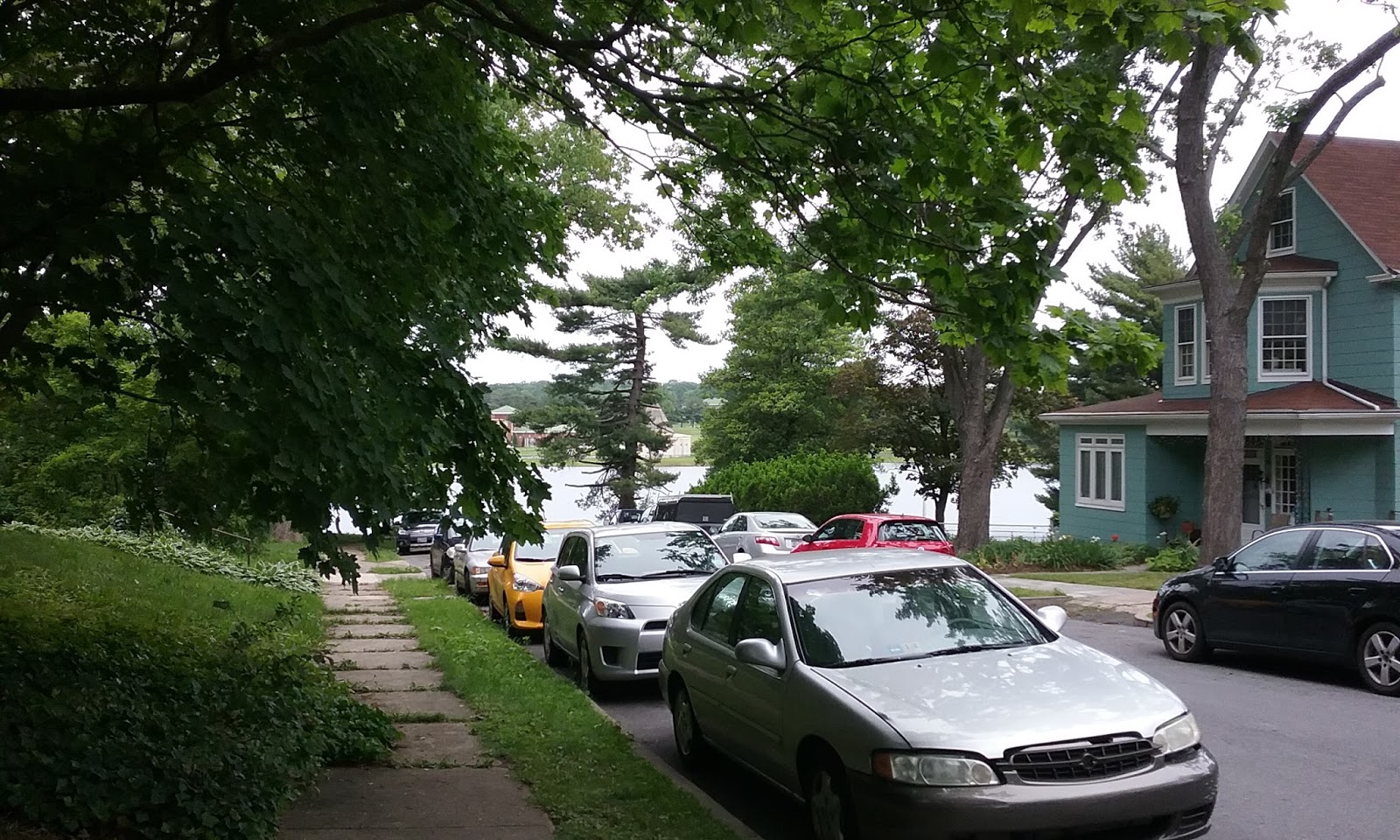
view of Lake Montebello from sidewalk in front of the house


Friday, May 12, 2017

Braided Rugs

I hope it's not too late for me to realize that I would like to be back in Gettysburg at this time of year while it's raining. I'm thinking now of visiting my grandparents near the end of a May and I was picked up at the Frederick bus station by my grandmother, a cousin, and a great uncle called Uncle Dump--the memory of finally returning to Gettysburg after being away for awhile as we turned up the Emmitsburg Road and then stopped at the old Visitors Center, where I browsed books. The warmth of my grandparents' home with the circular and oval braided rugs and a smell that I can't bring back. Sliced deli meats wrapped in white paper in their refrigerator fascinated me then because we almost never got that kind of thing where I grew up. The braided rugs also fascinated me when I was a little kid and we still lived in Pennsylvania. I used to try to roll marbles along the grooves, but it was the alternating colors--natural colors: browns, tans, greens, cream--that attracted me. I'm now reminded to look for one of these for my apartment in Baltimore.

I'd planned to be back in Gettysburg this week to attend a talk by an advocate against child sexual abuse and see my grandmother. But I've had to stay in Madison to catch up on grading and to sort through what to take to Baltimore. By not attending I feel that I've let her down and lost a chance. So I tried to make up for it by contacting on Thursday more people in the area to encourage them to attend. The rain and temperatures in the 50s yesterday were about the same as that time.

The rain in April and May also reminds me of walking back in the rain from a showing of the Umbrellas of Cherbourg at the National Gallery of Art. I wonder if my sadness then came from an unconscious awareness of something somewhat like it about to happen to me. And then the rain as I drove through Connecticut back from doing research one April in Boston. That's when a jazz piano work I've liked since I was in Kansas, Peace Piece by Bill Evans, took on the painful reminder feeling it now has for me.

Monday, May 08, 2017

Stephen King, Renoirs, and the USS Constellation

“The most important things are the hardest to say. They are the things you get ashamed of, because words diminish them -- words shrink things that seemed limitless when they were in your head to no more than living size when they're brought out. But it's more than that, isn't it? The most important things lie too close to wherever your secret heart is buried, like landmarks to a treasure your enemies would love to steal away. And you may make revelations that cost you dearly only to have people look at you in a funny way, not understanding what you've said at all, or why you thought it was so important that you almost cried while you were saying it. That's the worst, I think. When the secret stays locked within not for want of a teller but for want of an understanding ear.” Stephen King, first paragraph of "The Body," novella published in Different Seasons and basis for the movie Stand By Me.

art in the Baltimore Museum of Art by Pierre-Auguste Renoir,
father of Jean Renoir,  "Small Stooping Washerwoman" 
I worry that I've missed revelations like that from others. Or maybe at times I've heard, or at least have tried to, but have failed to convey that well enough. It's painful to be on the other end, trying to word feelings of that depth but not being heard or more often keeping them inside out of fear of little or no reaction.  And sometimes it's that the people who might be willing to listen are not the same as the one or those you wish would care. That problem reminds me of one of the most depressing movies I've ever seen--The Rules of the Game, the 1939 French film directed by Jean Renoir. I first saw it on Christmas night at an arthouse theater in Kansas City's Westport. Characters were shifting their romantic interests and they often failed to match. A would be interested in B, who was interested in C but not A. D would be interested in A, who was not interested in D. Something like that. I haven't seen this in a while. [Roger Ebert's review of The Rules of the Game.]


"Washerwomen" (left), "On the Shore of the Seine" (upper right), "The Reader" (lower right)


Below are some pictures I took last summer of the interior of the USS Constellation located in Baltimore. For most of the time, I was the only one on the deck. Feelings similar to what I've described above overcame me when I was where the ballast is stored in the hold. One of my thoughts was the realization that sometimes returns to me of experiencing things alone, similar to a painful moment that I don't want to describe online.  Part of that feeling was realizing that I might be a willing listener that the speaker wasn't so interested in opening up to. Another was of going through life like this, seeing sights but no one with whom to share experiences. The most common time for me to feel that, though, is in everyday settings.


Captain's quarters


Monday, April 24, 2017

Seen or Heard?: Art and Stopping Human Trafficking (Outdoor Display at UW-Madison in April 2016)

To what extent do people look at and are influenced by such displays? At least the creators and those directly affected might feel from these some kind of accomplishment, some kind of psychological help. But would those not already on board notice and take concrete steps? I suppose the accumulative effects of such efforts help the messages sink in. I wonder if a lingering student thought through this and decided to become an activist or an intern at the capitol was motivated to mention human trafficking to a legislator.

"...intentionally being shown outdoors so that it mimics the fact that trafficking exists all around us, hidden in plain sight."
Last April, from the 4th through the 25th, a photographic display on human trafficking--"Bought and Sold: Voices of Human Trafficking" by Kay Chernush--was placed in the mall that runs between the two halves of the Chazen Art Museum. It's a busy zone for students to walk between bus stops/dorms and the libraries/Memorial Union, so I hope many at least glanced at these to consider the problem. This coming week is a unit in my online classes on art, music, and animals in society, and I'm including these photos to help illustrate this use of art.

The photos with short captions are at the ArtWorks for Freedom website: 

Isthmus article: http://isthmus.com/events/kay-chernush/

To the left and right are the two halves of the Chazen; above and behind is the bridge connecting the two.


This one particularly drew my attention because of the idea of using a mask to survive. I'd add that those who kidnap, rape, and abuse wear "masks" to instigate these crimes and to fool themselves about their cruelty towards others.

The following display of paper cranes was placed in the Madison Public Library's Central Branch last April to observe Sexual Assault Awareness Month. One of my concerns is that these efforts risk being magical thought, which might serve some purposes, such as stress-reduction, but has little, if any, impact. I suppose this type of display is much more than magical thought and can work to convey the message. This is near where children with their parents might walk by to reach the children's books area, so maybe some asked about these and parents possibly discussed the topic of sexual assault and abuse.


Wednesday, April 19, 2017

Hidden/Open Treasures

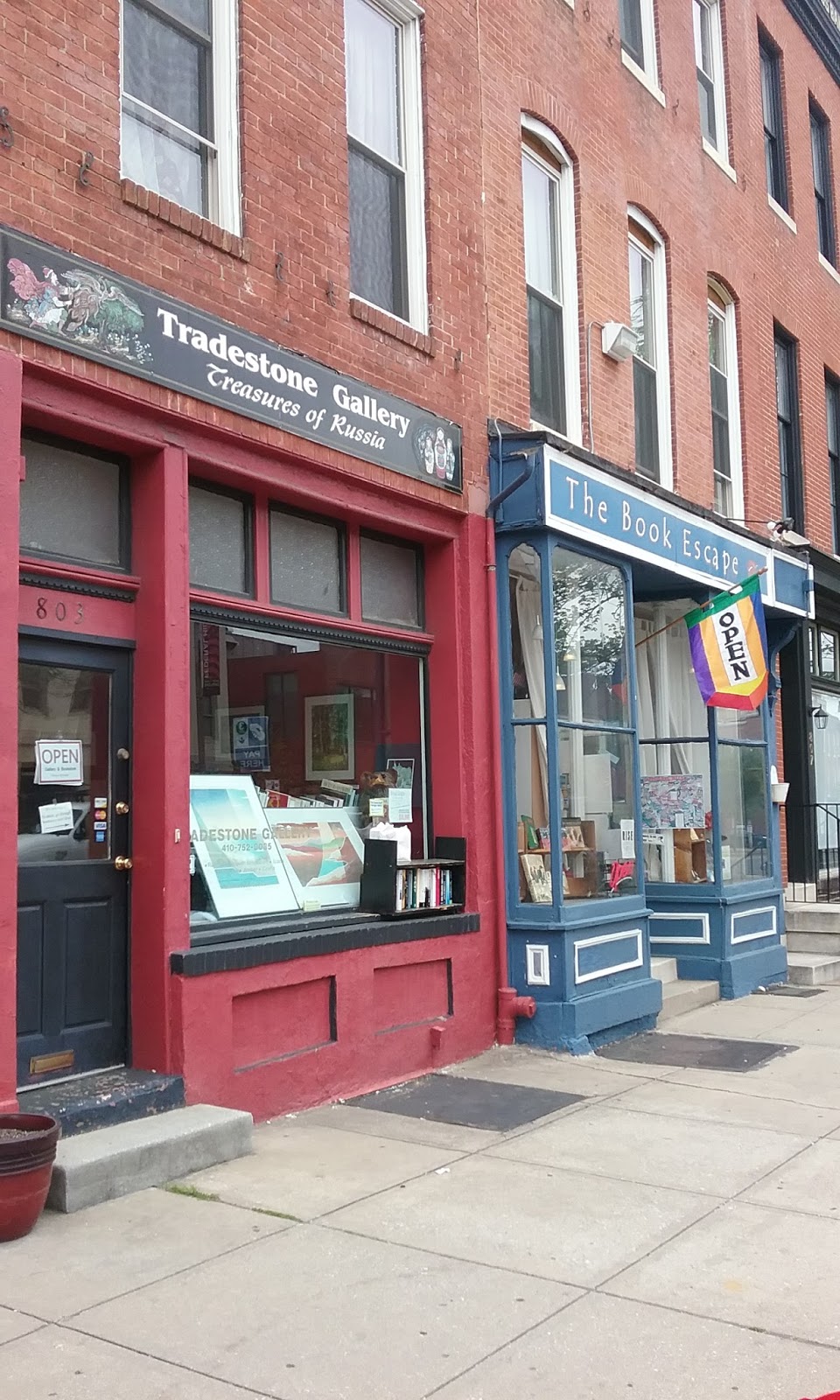
Book Escape, Light Street near Montgomery Street,
Baltimore (the store occupies both of these)
I finally got around to visiting a used book store in Baltimore that I'd planned to browse last year--Book Escape. My main goal was to see if they have any books I could use to study for the Maryland bar exam; however, as I thought would be the case, they didn't have any. I was surprised to find that behind the facade of the store, which combines two storefronts, is a small courtyard or atrium surrounded by the two buildings. I asked the book seller whether he knew anything about the background of this atrium or how common this kind of thing is in Baltimore, but he didn't know.

This reminds of Chinese courtyard houses that hide a courtyard filled with trees and maybe a small pond behind grey, often windowless, walls. Most of the courtyard houses in Beijing had to be divided up for multiple families who then erected small kitchens in the middle spaces. The courtyard of this bookstore is tiny, though, just enough to allow more windows in the houses.


Book Escape, one side of courtyard, toward front of the store

Book Escape, right side of store, through window to courtyard
Book Escape, left side of store, door to courtyard

I wonder about the relationship between this kind of hidden spot and the Do Ho Suh exhibit in my March 14, 2017, post. Even as a lot of us get revealed online, much is still hidden. But even what is open few care to glance at. It's like the experiment the Washington Post ran with violinist Joshua Bell in 2007: "Pearls Before Breakfast: Can one of the nation’s great musicians cut through the fog of a D.C. rush hour? Let’s find out."  By Gene Weingarten April 8, 2007.

"It was 7:51 a.m. on Friday, January 12, the middle of the morning rush hour. In the next 43 minutes, as the violinist performed six classical pieces, 1,097 people passed by. Almost all of them were on the way to work, which meant, for almost all of them, a government job. L’Enfant Plaza is at the nucleus of federal Washington, and these were mostly mid-level bureaucrats with those indeterminate, oddly fungible titles: policy analyst, project manager, budget officer, specialist, facilitator, consultant.

Each passerby had a quick choice to make, one familiar to commuters in any urban area where the occasional street performer is part of the cityscape: Do you stop and listen?" Only one person revealed that she recognized Bell. "In the three-quarters of an hour that Joshua Bell played, seven people stopped what they were doing to hang around and take in the performance, at least for a minute. Twenty-seven gave money, most of them on the run -- for a total of $32 and change. That leaves the 1,070 people who hurried by, oblivious, many only three feet away, few even turning to look." Here's a sped-up video of what happened: "Stop and Hear the Music." [2 min 36 sec]

Many people's lives seem to be like that as they hope to be noticed, not necessarily by many but enough to be cared for by at least one person. Everyday events and scenes are like Bell's performance, too. One of the key findings in the research by John and Julie Gottman on marriages is that happy couples are vastly more likely to respond to a partner's bid for connection or attention. (Short summary: "An Introduction to Emotional Bids and Trust." Longer Wisconsin Public Radio, "To the Best of Our Knowledge" interview: "Calculus of Love." [12 min 26 sec]

As I was leaving a student flute recital at the Peabody Conservatory, I was reminded of this research when I saw this.

Washington Monument in Baltimore (first major memorial to George Washington,
completed in 1829) More info at Mount Vernon Place Conservancy website


Sunday, March 26, 2017

Public Sculptures--"Green Man" by Mark Acton in Druid Hill Park, Baltimore


I think this is a neat way to create art in the park. According to a December 20, 2012, article in the Baltimore Sun, "Dead trees in Druid Hill Park are carved into sculptures," two red oaks had to be cut down in Druid Hill Park because of termite damage. The remaining tree stumps were more than 12 feet tall and 20 feet around.  Chain saw artist Mark Acton then turned them into 10-foot-tall busts of men with some connection to Druids and pagans: "The Druid" (on a hill north of the park's reservoir) and "The Green Man" (on the west end of the reservoir). I've not yet taken pictures of the one on the north side. The termite damage forced Acton to hollow out the stumps. I wonder what has been done to prevent further damage.


Tuesday, March 14, 2017

Transparent homes and the Web

Walking through this Do Ho Suh exhibit that replicates his former New York City apartment at the Madison Museum of Contemporary Art reminds me of what I'm doing to myself on the Web. 
translucent colored fabric replica of apartment at 348 West 22nd Street, New York NY


During the weekend of February 11, I decided to stay in Madison to catch the opening of the exhibit before returning to Baltimore. I think he's one of the most interesting artists these days. I wish I could see in person one of these: Floor, Karma (two giant feet walking over little people), and another statue called Karma that's 98 men stacked onto each other curving up 28 feet. In an interview [1 min 16 sec] for a public television program, "Art in the Twenty-First Century" (2003), he focuses on space when talking about Floor, but my first thought about Floor and the two giant feet is more about power and impact on other's/our lives. 


Taken on Saturday, Feb. 11--later they had to rope off these areas because
someone risked damaging the toilet by posing over it for a picture.


T
The exhibit also reminds me about the role of places in my life, of how they connect to my memories, other people, and dreams. Do Ho Suh describes similar thoughts in the video "Rubbing"/"Loving" [6 min 16 sec]. Maybe I shouldn't go into detail here about the places I think of and their relevance to me.

Life-size rubbing of his apartment


In a darkened room were appliances and similar objects on their own.


Thursday, March 09, 2017

Akan proverb at the Baltimore Museum of Art/Guerrilla Girls exhibit

Akan Gold-Dust Weight (Abrammuo)
While visiting the Baltimore Museum of Art this week to look again at a temporary exhibit of the Guerrilla Girls and take some photos to use in my classes, I stopped by a case of small ornaments used as weights by Akan gold merchants of Africa. (The Akan are an ethnic group that makes up much of the populations of Ghana and the Ivory Coast.)  This bird symbolizes an Akan proverb: "When it lies behind you, take it." According to the sign, this is about learning from the past. Because I wondered why a bird looking behind itself was chosen to represent this idea, I did some searching and found that a name for the symbol is sankofa.

from the Spiritual Project of the University of Denver:
"Sankofa is an Akan term that literally means, 'to go back and get it.' One of the Adinkra symbols for Sankofa...depicts a mythical bird flying forward with its head turned backward. The egg in its mouth represents the 'gems' or knowledge of the past upon which wisdom is based; it also signifies the generation to come that would benefit from that wisdom. This symbol often is associated with the proverb, 'Se wo were fi na wosankofa a yenkyi,' which translates to, 'It is not wrong to go back for that which you have forgotten.' The Akan believe that the past illuminates the present and that the search for knowledge is a life-long process. The pictograph illustrates the quest for knowledge, while the proverb suggests the rightness of such a quest as long as it is based on knowledge of the past. (san = 'to return') + (ko = 'to go') + (fa = 'to look, to seek and take')"

But the bird in the BMA collection doesn't seem to have an egg in its mouth.

One of the ways I try to follow this idea is through listening to music, especially songs that bring back the emotions of painful moments or that puncture into me that some thoughts were dreams that weren't coming true. This gets into topics that are too personal for me to post on here. Maybe my tendency is to ruminate too much on my past mistakes.

The BMA's Guerrilla Girls exhibit (September 25, 2016 — March 12, 2017) filled the walls with posters like this one:

2012 version of this poster (See the Guerrilla Girls "Naked through the Ages" page)


I'm amazed at how many great artists who are women fail to get much attention in our museums. I was once again reminded of this when I was looking into abstract expressionism recently and came across articles inspired by an exhibit that started at the Denver Art Museum in 2016: Women of Abstract Expressionism. (I was thinking about abstract expressionism because I'm using Pinterest to create my own imaginary art museum as a fun way to learn more about art.) I've not been a big fan of abstract expressionism, but I really like paintings by some of the artists described in the following articles, such as Mary Abbott and Janet Sobel:

1. "11 Female Abstract Expressionists You Should Know, from Joan Mitchell to Alma Thomas" by Alexxa Gotthardt, June 29, 2016 http://bit.ly/293kDVI
1985 to 1987; 1987 to 1989

2. "12 Women of Abstract Expressionism to Know Now" by Sarah Cascone, September 17, 2016 http://artnt.cm/2cxVu74
Neither article mentions Janet Sobel, who influenced Pollock. See "The Forgotten Female Artist: Janet Sobel’s Struggle within the Abstract Expressionist Movement": http://the-artifice.com/janet-sobel-abstract-expressionist-movement/


1989 to 1992; 1992 to 1999

1999 to 2012


Tuesday, December 20, 2016

Madison's Art on the Square Fair: "Art is a form of communication"

[I wrote most of this in July 2015 but didn't post it.]


Last weekend was the annual Art on the Square in Madison, with booths lining both sides of the streets that form the capitol square. If I'm in Madison during the fair, I nearly always go but nearly always leave feeling somewhat unfulfilled. The main exception and what's almost always my favorite stop is the high school ceramics booth, which is part of the Wisconsin-focused Art Fair Off the Square along Martin Luther King Jr Blvd, the street extending from the square to the Monona Terrace.

 “Art is a form of communication and when you have customers responding to your art, that’s what it’s all about,” said Phi Lyons, ceramics teacher at West, quoted in "Students' Clay Coalition Get Supportive Audience" Wisconsin State Journal July 20, 2015

Many of the students were there to talk with customers. At least a couple of them described to me the psychological benefits of pottery, that it could have a relaxing, meditative effect to help them deal with, for example, trauma or depression. One of the units in my intro sociology and contemporary American society classes includes the sociology of art because of those two reasons along with others. See the "Art in Cyberspace" website for links to various kinds of resources on the sociology of art.

Thursday, July 07, 2016

Baltimore--Part I

During recent months I've been reading up on Baltimore to prepare for moving there, such as Not in My Neighborhood: How Bigotry Shaped a Great American City, The Hero's Fight: African Americans in West Baltimore and the Shadow of the State, and Coming of Age in the Other America. For too long I've neglected the city in favor of DC, but the teaching opportunities seem to fit me better in Baltimore, and, although the cost of living isn't cheap there, at least it's not as expensive as DC. For instance, a large studio apartment that I rented in 1996 near the Rosslyn Metro station in Arlington, VA, for under $450/month now costs over $1,300/month.

My parents met in DC when my mom was in nursing school and my father at a trade school. Even though my mom's side of my family in the Salisbury area has tended to focus on Baltimore--the male sailors seemed to have often laid over from the 1800s through the mid-1900s--until recently I'd spent little time there, mainly stopping over before my mom's cousin or brother drove us to the Eastern Shore. At least I did have the chance to eat at Haussner's Restaurant, famous for the art that covered its walls. Because of the tourist spots, federal government, National Mall, Metro, etc., DC seemed much more attractive to me.

Rawlings Conservatory and Botanic Gardens in Druid Hill Park, opened in 1888. The architectural style of this time period, such as the Smithsonian's Arts and Industries Building (opened in 1881), is among my favorites.

In some ways Baltimore reminds me of some Chinese cities of the 1990s--lots of problems, though not necessarily the same, but many nice people.

George Peabody Library, part of the Johns Hopkins University

Too common sight in West Baltimore (See "A Tale of Two Cities" Baltimore Magazine, April 2016) In the future I should post a photo that portrays a more positive side.

Monday, June 20, 2016

Dane County Farmers' Market (Madison, WI)


Dane County Farmers' Market along Mifflin Street (It's usually much more crowded than this. Some vendors are missing.)
During warm weather the Dane County Farmers' Market is held on the sidewalks surrounding the state capitol and is the largest producer-only farmers' market in the US. On Saturdays from early morning until about 1 to 2 pm, when the vendors must be gone, the sidewalks are often packed during good weather. Prices seem to be better than at a typical farmers' market and even sometimes cheaper than at a grocery store. This past Saturday I bought a large bag of spinach for $2, and the seller gave me a bunch of lettuce for free. I tried to offer some money for the lettuce but she refused.

Lettuce and spinach


Pink Pearl apple
My favorite vendors are Weston's Antique Apples (because of the uncommon apples, such as ones that are red inside, sold late summer through fall), Green Barn Farm Market (because of the reasonable prices for basic vegetables), and Marsden's Pure Honey (because he sells honey from specific flowers). At least a couple of the cheese vendors have won prizes in international cheese competitions, and maybe all of them offer samples.


Sunday, May 22, 2016

Why people might visit this site and commenting

I sometimes look at the visitor counters for this site to see where visitors live and what they've searched for. Among the more common searches are for something about Madison, textbooks, stereoviews, a rare vegetable, Frank Lloyd Wright, or the Aldo Leopold shack. My name appears, too, and maybe many of those are students or someone looking for another Chuck Ditzler. The web visit counters aren't so good--often not recording well the cities or lacking an indication of how the visitor ended up here.

It can feel somewhat invasive or concerning to know that someone might be searching about me. But I'd feel fine and possibly happy if it were simply out of curiosity about me or something I've said. If you are visiting here for those reasons, please don't hesitate to comment or mention to me what you've read.