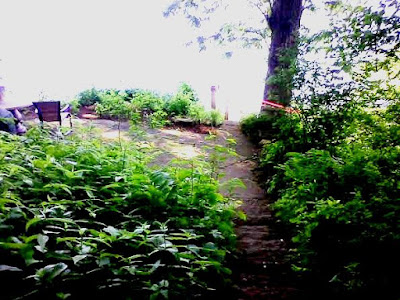
Sachs Covered Bridge; Adams County, PA

Sachs Covered Bridge; Adams County, PA

Monday, May 08, 2017

Stephen King, Renoirs, and the USS Constellation

“The most important things are the hardest to say. They are the things you get ashamed of, because words diminish them -- words shrink things that seemed limitless when they were in your head to no more than living size when they're brought out. But it's more than that, isn't it? The most important things lie too close to wherever your secret heart is buried, like landmarks to a treasure your enemies would love to steal away. And you may make revelations that cost you dearly only to have people look at you in a funny way, not understanding what you've said at all, or why you thought it was so important that you almost cried while you were saying it. That's the worst, I think. When the secret stays locked within not for want of a teller but for want of an understanding ear.” Stephen King, first paragraph of "The Body," novella published in Different Seasons and basis for the movie Stand By Me.

art in the Baltimore Museum of Art by Pierre-Auguste Renoir,
father of Jean Renoir,  "Small Stooping Washerwoman" 
I worry that I've missed revelations like that from others. Or maybe at times I've heard, or at least have tried to, but have failed to convey that well enough. It's painful to be on the other end, trying to word feelings of that depth but not being heard or more often keeping them inside out of fear of little or no reaction.  And sometimes it's that the people who might be willing to listen are not the same as the one or those you wish would care. That problem reminds me of one of the most depressing movies I've ever seen--The Rules of the Game, the 1939 French film directed by Jean Renoir. I first saw it on Christmas night at an arthouse theater in Kansas City's Westport. Characters were shifting their romantic interests and they often failed to match. A would be interested in B, who was interested in C but not A. D would be interested in A, who was not interested in D. Something like that. I haven't seen this in a while. [Roger Ebert's review of The Rules of the Game.]


"Washerwomen" (left), "On the Shore of the Seine" (upper right), "The Reader" (lower right)


Below are some pictures I took last summer of the interior of the USS Constellation located in Baltimore. For most of the time, I was the only one on the deck. Feelings similar to what I've described above overcame me when I was where the ballast is stored in the hold. One of my thoughts was the realization that sometimes returns to me of experiencing things alone, similar to a painful moment that I don't want to describe online.  Part of that feeling was realizing that I might be a willing listener that the speaker wasn't so interested in opening up to. Another was of going through life like this, seeing sights but no one with whom to share experiences. The most common time for me to feel that, though, is in everyday settings.


Captain's quarters


Monday, April 24, 2017

Seen or Heard?: Art and Stopping Human Trafficking (Outdoor Display at UW-Madison in April 2016)

To what extent do people look at and are influenced by such displays? At least the creators and those directly affected might feel from these some kind of accomplishment, some kind of psychological help. But would those not already on board notice and take concrete steps? I suppose the accumulative effects of such efforts help the messages sink in. I wonder if a lingering student thought through this and decided to become an activist or an intern at the capitol was motivated to mention human trafficking to a legislator.

"...intentionally being shown outdoors so that it mimics the fact that trafficking exists all around us, hidden in plain sight."
Last April, from the 4th through the 25th, a photographic display on human trafficking--"Bought and Sold: Voices of Human Trafficking" by Kay Chernush--was placed in the mall that runs between the two halves of the Chazen Art Museum. It's a busy zone for students to walk between bus stops/dorms and the libraries/Memorial Union, so I hope many at least glanced at these to consider the problem. This coming week is a unit in my online classes on art, music, and animals in society, and I'm including these photos to help illustrate this use of art.

The photos with short captions are at the ArtWorks for Freedom website: 

Isthmus article: http://isthmus.com/events/kay-chernush/

To the left and right are the two halves of the Chazen; above and behind is the bridge connecting the two.


This one particularly drew my attention because of the idea of using a mask to survive. I'd add that those who kidnap, rape, and abuse wear "masks" to instigate these crimes and to fool themselves about their cruelty towards others.

The following display of paper cranes was placed in the Madison Public Library's Central Branch last April to observe Sexual Assault Awareness Month. One of my concerns is that these efforts risk being magical thought, which might serve some purposes, such as stress-reduction, but has little, if any, impact. I suppose this type of display is much more than magical thought and can work to convey the message. This is near where children with their parents might walk by to reach the children's books area, so maybe some asked about these and parents possibly discussed the topic of sexual assault and abuse.


Wednesday, April 19, 2017

Hidden/Open Treasures

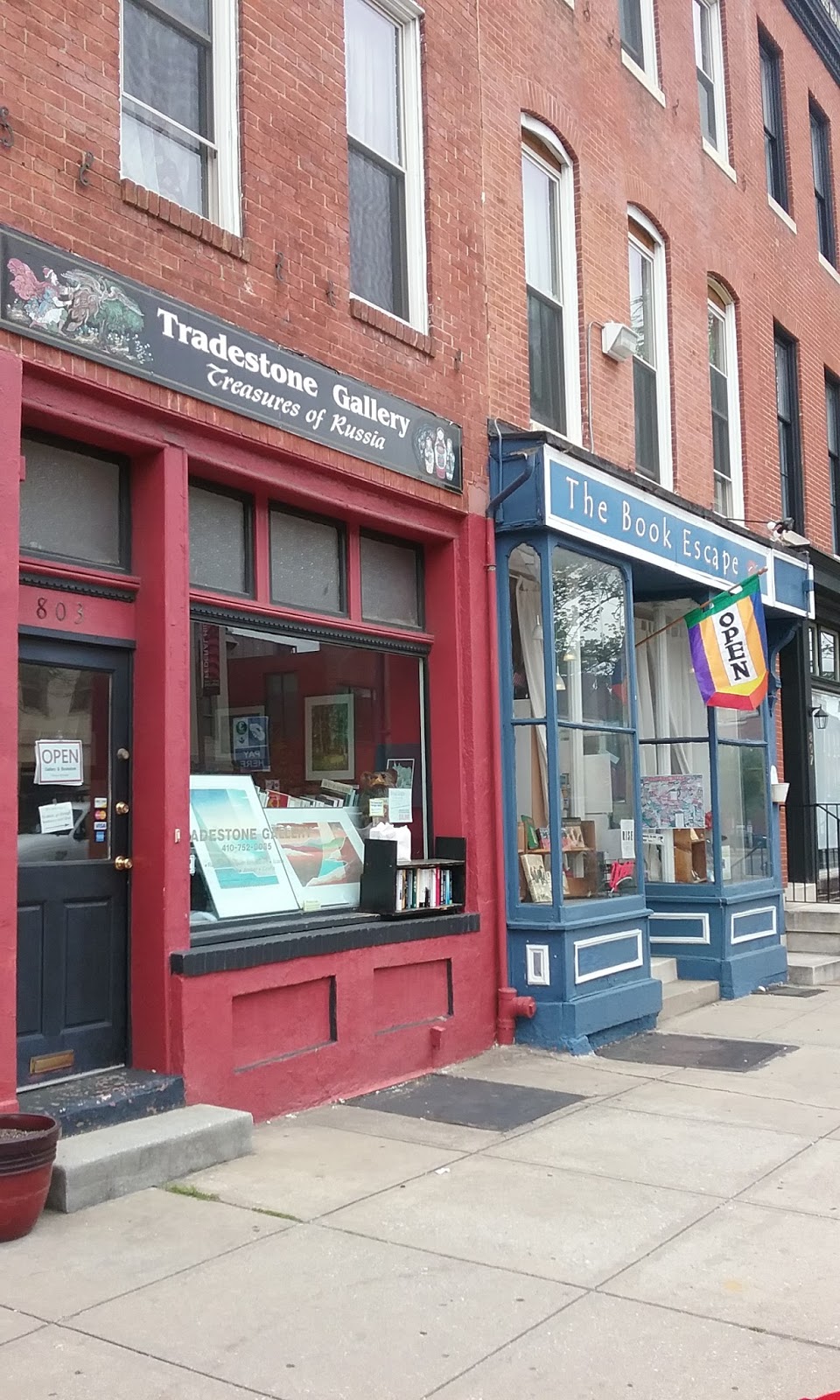
Book Escape, Light Street near Montgomery Street,
Baltimore (the store occupies both of these)
I finally got around to visiting a used book store in Baltimore that I'd planned to browse last year--Book Escape. My main goal was to see if they have any books I could use to study for the Maryland bar exam; however, as I thought would be the case, they didn't have any. I was surprised to find that behind the facade of the store, which combines two storefronts, is a small courtyard or atrium surrounded by the two buildings. I asked the book seller whether he knew anything about the background of this atrium or how common this kind of thing is in Baltimore, but he didn't know.

This reminds of Chinese courtyard houses that hide a courtyard filled with trees and maybe a small pond behind grey, often windowless, walls. Most of the courtyard houses in Beijing had to be divided up for multiple families who then erected small kitchens in the middle spaces. The courtyard of this bookstore is tiny, though, just enough to allow more windows in the houses.


Book Escape, one side of courtyard, toward front of the store

Book Escape, right side of store, through window to courtyard
Book Escape, left side of store, door to courtyard

I wonder about the relationship between this kind of hidden spot and the Do Ho Suh exhibit in my March 14, 2017, post. Even as a lot of us get revealed online, much is still hidden. But even what is open few care to glance at. It's like the experiment the Washington Post ran with violinist Joshua Bell in 2007: "Pearls Before Breakfast: Can one of the nation’s great musicians cut through the fog of a D.C. rush hour? Let’s find out."  By Gene Weingarten April 8, 2007.

"It was 7:51 a.m. on Friday, January 12, the middle of the morning rush hour. In the next 43 minutes, as the violinist performed six classical pieces, 1,097 people passed by. Almost all of them were on the way to work, which meant, for almost all of them, a government job. L’Enfant Plaza is at the nucleus of federal Washington, and these were mostly mid-level bureaucrats with those indeterminate, oddly fungible titles: policy analyst, project manager, budget officer, specialist, facilitator, consultant.

Each passerby had a quick choice to make, one familiar to commuters in any urban area where the occasional street performer is part of the cityscape: Do you stop and listen?" Only one person revealed that she recognized Bell. "In the three-quarters of an hour that Joshua Bell played, seven people stopped what they were doing to hang around and take in the performance, at least for a minute. Twenty-seven gave money, most of them on the run -- for a total of $32 and change. That leaves the 1,070 people who hurried by, oblivious, many only three feet away, few even turning to look." Here's a sped-up video of what happened: "Stop and Hear the Music." [2 min 36 sec]

Many people's lives seem to be like that as they hope to be noticed, not necessarily by many but enough to be cared for by at least one person. Everyday events and scenes are like Bell's performance, too. One of the key findings in the research by John and Julie Gottman on marriages is that happy couples are vastly more likely to respond to a partner's bid for connection or attention. (Short summary: "An Introduction to Emotional Bids and Trust." Longer Wisconsin Public Radio, "To the Best of Our Knowledge" interview: "Calculus of Love." [12 min 26 sec]

As I was leaving a student flute recital at the Peabody Conservatory, I was reminded of this research when I saw this.

Washington Monument in Baltimore (first major memorial to George Washington,
completed in 1829) More info at Mount Vernon Place Conservancy website


Sunday, March 26, 2017

Public Sculptures--"Green Man" by Mark Acton in Druid Hill Park, Baltimore


I think this is a neat way to create art in the park. According to a December 20, 2012, article in the Baltimore Sun, "Dead trees in Druid Hill Park are carved into sculptures," two red oaks had to be cut down in Druid Hill Park because of termite damage. The remaining tree stumps were more than 12 feet tall and 20 feet around.  Chain saw artist Mark Acton then turned them into 10-foot-tall busts of men with some connection to Druids and pagans: "The Druid" (on a hill north of the park's reservoir) and "The Green Man" (on the west end of the reservoir). I've not yet taken pictures of the one on the north side. The termite damage forced Acton to hollow out the stumps. I wonder what has been done to prevent further damage.


Tuesday, March 14, 2017

Transparent homes and the Web

Walking through this Do Ho Suh exhibit that replicates his former New York City apartment at the Madison Museum of Contemporary Art reminds me of what I'm doing to myself on the Web. 
translucent colored fabric replica of apartment at 348 West 22nd Street, New York NY


During the weekend of February 11, I decided to stay in Madison to catch the opening of the exhibit before returning to Baltimore. I think he's one of the most interesting artists these days. I wish I could see in person one of these: Floor, Karma (two giant feet walking over little people), and another statue called Karma that's 98 men stacked onto each other curving up 28 feet. In an interview [1 min 16 sec] for a public television program, "Art in the Twenty-First Century" (2003), he focuses on space when talking about Floor, but my first thought about Floor and the two giant feet is more about power and impact on other's/our lives. 


Taken on Saturday, Feb. 11--later they had to rope off these areas because
someone risked damaging the toilet by posing over it for a picture.


T
The exhibit also reminds me about the role of places in my life, of how they connect to my memories, other people, and dreams. Do Ho Suh describes similar thoughts in the video "Rubbing"/"Loving" [6 min 16 sec]. Maybe I shouldn't go into detail here about the places I think of and their relevance to me.

Life-size rubbing of his apartment


In a darkened room were appliances and similar objects on their own.


Thursday, March 09, 2017

Akan proverb at the Baltimore Museum of Art/Guerrilla Girls exhibit

Akan Gold-Dust Weight (Abrammuo)
While visiting the Baltimore Museum of Art this week to look again at a temporary exhibit of the Guerrilla Girls and take some photos to use in my classes, I stopped by a case of small ornaments used as weights by Akan gold merchants of Africa. (The Akan are an ethnic group that makes up much of the populations of Ghana and the Ivory Coast.)  This bird symbolizes an Akan proverb: "When it lies behind you, take it." According to the sign, this is about learning from the past. Because I wondered why a bird looking behind itself was chosen to represent this idea, I did some searching and found that a name for the symbol is sankofa.

from the Spiritual Project of the University of Denver:
"Sankofa is an Akan term that literally means, 'to go back and get it.' One of the Adinkra symbols for Sankofa...depicts a mythical bird flying forward with its head turned backward. The egg in its mouth represents the 'gems' or knowledge of the past upon which wisdom is based; it also signifies the generation to come that would benefit from that wisdom. This symbol often is associated with the proverb, 'Se wo were fi na wosankofa a yenkyi,' which translates to, 'It is not wrong to go back for that which you have forgotten.' The Akan believe that the past illuminates the present and that the search for knowledge is a life-long process. The pictograph illustrates the quest for knowledge, while the proverb suggests the rightness of such a quest as long as it is based on knowledge of the past. (san = 'to return') + (ko = 'to go') + (fa = 'to look, to seek and take')"

But the bird in the BMA collection doesn't seem to have an egg in its mouth.

One of the ways I try to follow this idea is through listening to music, especially songs that bring back the emotions of painful moments or that puncture into me that some thoughts were dreams that weren't coming true. This gets into topics that are too personal for me to post on here. Maybe my tendency is to ruminate too much on my past mistakes.

The BMA's Guerrilla Girls exhibit (September 25, 2016 — March 12, 2017) filled the walls with posters like this one:

2012 version of this poster (See the Guerrilla Girls "Naked through the Ages" page)


I'm amazed at how many great artists who are women fail to get much attention in our museums. I was once again reminded of this when I was looking into abstract expressionism recently and came across articles inspired by an exhibit that started at the Denver Art Museum in 2016: Women of Abstract Expressionism. (I was thinking about abstract expressionism because I'm using Pinterest to create my own imaginary art museum as a fun way to learn more about art.) I've not been a big fan of abstract expressionism, but I really like paintings by some of the artists described in the following articles, such as Mary Abbott and Janet Sobel:

1. "11 Female Abstract Expressionists You Should Know, from Joan Mitchell to Alma Thomas" by Alexxa Gotthardt, June 29, 2016 http://bit.ly/293kDVI
1985 to 1987; 1987 to 1989

2. "12 Women of Abstract Expressionism to Know Now" by Sarah Cascone, September 17, 2016 http://artnt.cm/2cxVu74
Neither article mentions Janet Sobel, who influenced Pollock. See "The Forgotten Female Artist: Janet Sobel’s Struggle within the Abstract Expressionist Movement": http://the-artifice.com/janet-sobel-abstract-expressionist-movement/


1989 to 1992; 1992 to 1999

1999 to 2012


Tuesday, December 20, 2016

Madison's Art on the Square Fair: "Art is a form of communication"

[I wrote most of this in July 2015 but didn't post it.]


Last weekend was the annual Art on the Square in Madison, with booths lining both sides of the streets that form the capitol square. If I'm in Madison during the fair, I nearly always go but nearly always leave feeling somewhat unfulfilled. The main exception and what's almost always my favorite stop is the high school ceramics booth, which is part of the Wisconsin-focused Art Fair Off the Square along Martin Luther King Jr Blvd, the street extending from the square to the Monona Terrace.

 “Art is a form of communication and when you have customers responding to your art, that’s what it’s all about,” said Phi Lyons, ceramics teacher at West, quoted in "Students' Clay Coalition Get Supportive Audience" Wisconsin State Journal July 20, 2015

Many of the students were there to talk with customers. At least a couple of them described to me the psychological benefits of pottery, that it could have a relaxing, meditative effect to help them deal with, for example, trauma or depression. One of the units in my intro sociology and contemporary American society classes includes the sociology of art because of those two reasons along with others. See the "Art in Cyberspace" website for links to various kinds of resources on the sociology of art.

Thursday, July 07, 2016

Baltimore--Part I

During recent months I've been reading up on Baltimore to prepare for moving there, such as Not in My Neighborhood: How Bigotry Shaped a Great American City, The Hero's Fight: African Americans in West Baltimore and the Shadow of the State, and Coming of Age in the Other America. For too long I've neglected the city in favor of DC, but the teaching opportunities seem to fit me better in Baltimore, and, although the cost of living isn't cheap there, at least it's not as expensive as DC. For instance, a large studio apartment that I rented in 1996 near the Rosslyn Metro station in Arlington, VA, for under $450/month now costs over $1,300/month.

My parents met in DC when my mom was in nursing school and my father at a trade school. Even though my mom's side of my family in the Salisbury area has tended to focus on Baltimore--the male sailors seemed to have often laid over from the 1800s through the mid-1900s--until recently I'd spent little time there, mainly stopping over before my mom's cousin or brother drove us to the Eastern Shore. At least I did have the chance to eat at Haussner's Restaurant, famous for the art that covered its walls. Because of the tourist spots, federal government, National Mall, Metro, etc., DC seemed much more attractive to me.

Rawlings Conservatory and Botanic Gardens in Druid Hill Park, opened in 1888. The architectural style of this time period, such as the Smithsonian's Arts and Industries Building (opened in 1881), is among my favorites.

In some ways Baltimore reminds me of some Chinese cities of the 1990s--lots of problems, though not necessarily the same, but many nice people.

George Peabody Library, part of the Johns Hopkins University

Too common sight in West Baltimore (See "A Tale of Two Cities" Baltimore Magazine, April 2016) In the future I should post a photo that portrays a more positive side.

Monday, June 20, 2016

Dane County Farmers' Market (Madison, WI)


Dane County Farmers' Market along Mifflin Street (It's usually much more crowded than this. Some vendors are missing.)
During warm weather the Dane County Farmers' Market is held on the sidewalks surrounding the state capitol and is the largest producer-only farmers' market in the US. On Saturdays from early morning until about 1 to 2 pm, when the vendors must be gone, the sidewalks are often packed during good weather. Prices seem to be better than at a typical farmers' market and even sometimes cheaper than at a grocery store. This past Saturday I bought a large bag of spinach for $2, and the seller gave me a bunch of lettuce for free. I tried to offer some money for the lettuce but she refused.

Lettuce and spinach


Pink Pearl apple
My favorite vendors are Weston's Antique Apples (because of the uncommon apples, such as ones that are red inside, sold late summer through fall), Green Barn Farm Market (because of the reasonable prices for basic vegetables), and Marsden's Pure Honey (because he sells honey from specific flowers). At least a couple of the cheese vendors have won prizes in international cheese competitions, and maybe all of them offer samples.


Sunday, May 22, 2016

Why people might visit this site and commenting

I sometimes look at the visitor counters for this site to see where visitors live and what they've searched for. Among the more common searches are for something about Madison, textbooks, stereoviews, a rare vegetable, Frank Lloyd Wright, or the Aldo Leopold shack. My name appears, too, and maybe many of those are students or someone looking for another Chuck Ditzler. The web visit counters aren't so good--often not recording well the cities or lacking an indication of how the visitor ended up here.

It can feel somewhat invasive or concerning to know that someone might be searching about me. But I'd feel fine and possibly happy if it were simply out of curiosity about me or something I've said. If you are visiting here for those reasons, please don't hesitate to comment or mention to me what you've read.

Wednesday, December 09, 2015

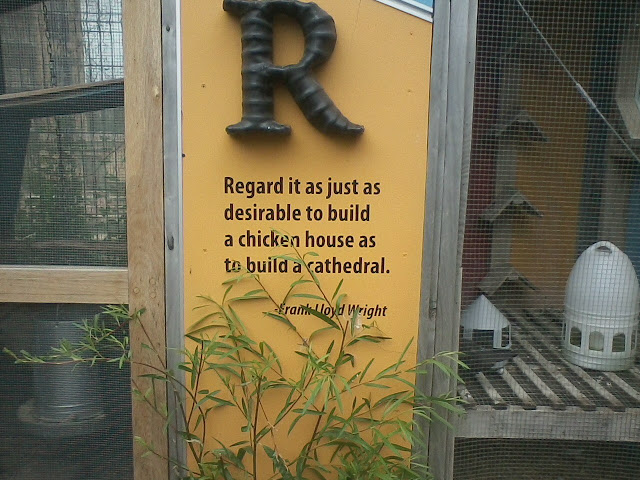
"Regard it as just as desirable to build a chicken house as to build a cathedral.” Frank Lloyd Wright "Two Lectures on Architecture" (1931)


photo of FLW quotation on Madison Children's Museum chicken coop


While visiting the Madison Children's Museum, which was free one Saturday in June, I came across this quotation from Frank Lloyd Wright on the rooftop combination pigeon/chicken coop. It's the first sentence of #12 in a list of 14 pieces of advice that end the second lecture, originally delivered at the Art Institute of Chicago on October 2, 1930, "To the Young Man in Architecture."

Here's the full piece of advice: 
12. Regard it as just as desirable to build a chickenhouse as to build a cathedral. The size of the project means little in art, beyond the money matter. It is the quality of character that really counts. Character may be large in the little or little in the large.

This idea fits well the houses I visited the previous Saturday, June 6, as part of the annual Wright in Wisconsin tour, which this year was held in Madison. Within about a five-mile radius of where I live are ten buildings designed by Wright: eight houses, the First Unitarian Church of Madison, and the Monona Terrace Community and Convention Center. (I'm including the newly "discovered" American System-Built House by Monroe Street.) Of the Wright buildings, however, only three houses, the church, and the Monona Terrace were open for the tour. The other five houses on the tour were designed by apprentices: William Wesley Peters, John Howe, Edgar Tafel, Herb Fritz, and Herb Delevie.

I'll post at another time photos of the Jacobs House I (the first Usonian and also called Jacobs I), which I've visited twice. I'm disappointed that the Jacobs House II, which I've never visited, was not part of this tour because of its interesting semi-circular design built into a berm. A former owner created a website, "Making Wright Right," with lots of information. Here's what he said about heating after he had made some improvements, such as to the insulation:

"The design works. On the coldest winter day, if there is sun, the house is warm and the heat does not need to run. The mass of the floor and stone allow some of that heat to be used later.

"The other heat source was a radiant floor. What a wonderful way to heat! The heat rising from such a large surface allows a much lower than normal house temperature. Going barefoot during winter on a concrete slab is a very enjoyable experience. The heat is much more even than in a house which uses radiators and humidity always stays about 50%."

The Pew House (built 1939-40)
I was especially looking forward to visiting the Pew House, which is rarely open to the public. Because this house in Shorewood Hills (a small city between Lake Mendota and Madison) sits over a small ravine that leads to the lake, it has been called a poor man's Fallingwater, to which Wright responded that Fallingwater is a rich man's Pew House.  Although Usonians typically have only one story, this has two, with the bedrooms on the top.
Drive leading from Lake Mendota Drive to the house, which can't be easily seen from the street.
Across the street is the north side of the Blackhawk Country Club.  If I'm in Madison on July 4th, 
I walk from my place to the south side of the golf course to watch the fireworks display.
Main entrance on the left through the small carport

The side facing Lake Mendota is much nicer and is a good example of the Usonian ideal of connecting interior and exterior spaces. We were not allowed to take pictures inside the house, but interior views can be found at this website: http://www.oldhouseonline.com/frank-lloyd-wright-fallingwater-minor/  I like the brown colors of the interior, although I'd prefer a little more regular white walls. While there, I wondered if small things, such as coins or paperclips, might fall through the 1/8 inch spaces between the planks of the living room floor. Those spaces allow heat to flow better from the hot water pipes of the radiant heating system. (Both of the Jacobs houses use radiant heat, but the pipes were embedded in or under the cement floors. I think that the current owner of Jacobs I told me that he had to use a jackhammer to break up the floor to replace the old pipes.)

Left or east part of the lakeside of Pew House--
A tiny ravine to the lake runs from under the house through the foliage by the tree. 
West part of the lakeside of Pew House--The main entrance is at the lower right of the house.
Stairs lead from there to the lake behind the shrubbery in this photo.
Small ravine under the house. The actual stream was modified, so this water is pumped.


View of Lake Mendota from the path. Stairs lead down to the shore.


Additional information on the Pew House
John Pew was a chemist at the US Forest Products Laboratory, which is about a mile southeast of the Pew House. He and his wife, Ruth Pew, originally wanted a colonial; however, the cost was too high. The architect they were interested in asked his draftsman, Herb Fritz to take over. This was soon before Fritz became an apprentice at Wright's Taliesen, but he was already convincing the Pews about the merits of a Usonian on the narrow plot they had bought at the lakeshore.

Fritz then connected them with Wright, who asked them to buy an additional 25 feet along the lake, thus totaling 75 feet of shoreline. Wright asked each of his apprentices to design a house for the site, but they all were aligned as usual to parallel the street. Wright thought it best to bridge the small ravine closer to the lake and then turn the house at an angle so that two sides would have lake views. After Wright sketched the basic plan, he asked Fritz to create the more detailed perspectives. Because the area contractors were too expensive, Wesley Peters, Wright's main apprentice, ended up in that role.

Interesting digression:
Peters married Wright's adopted daughter Svetlana, who died in a car accident in 1946. From 1970 to 73, Peters was married to another Svetlana--Svetlana Alliyeva, Joseph Stalin's daughter who defected to the US in the 1960s. According to a 2014 New Yorker article, "My Friend, Stalin's Daughter," Wright's widow, Olgivanna, introduced the two at Taliesen West in 1970 because she "believed that Svetlana was a reincarnation of her (biological) daughter. Her hope was that this new Svetlana would marry the previous one’s widower—Wesley Peters." After marrying Peters, the couple lived at Taliesen West with Olgivanna, but Svetlana felt that she was as authoritarian as her father had been. 

In 2011 Svetlana Alliyeva, who had changed her name to Lana Peters, died in Richland Center, Wisconsin, a town 60 miles northwest of Madison and where Wright was born in 1867. Her mother committed suicide in 1932 when she was six. The only daughter of Stalin, she took her mother's last name after he died in 1953. For more, see an April 17, 2010 article in the Wisconsin State Journal based on an interview of her, "Lana on Svetlana: Stalin's Daughter on Her Life in Wisconsin." (These weird connections remind me of many stories about the Battle of Gettysburg, such as about General Dan Sickles and the fence that surrounds the National Cemetery at Gettysburg.)